flowchart RL
    A[A at t1]
    B[B at t2]
    B e1@== remembers ==> A
    e1@{ animate: true }
Psychological theories of diachronic identity
Abstract
Slides for Metaphysics.
Slide commands
- Next slide: right arrow / space /
n - Previous slide: left arrow /
p - Fullscreen mode:
f - Overview mode:
o - Activate tools:
m - Activate pointer:
q - Jump to slide:
gthen type slide number
For a full list of options, see Presenting Slides
Same psychology theory
Problems
- Vague: what does “same psychology” mean?
- False: No core part of your psychology that stays the same
Simple memory theory
Problem:
- We are not always remembering our prior selves
- We don’t have perfect memories of the past.
Revisions
What kind of memory?
Tek is actively remembering what he did yesterday.
- Occurrent memory
- Dispositional memory
What kind of memory?
Tek could remember his locker combination but right now he is solving a Rubik’s cube.
- Occurrent memory
- Dispositional memory
What kind of memory?
Tek remembers that Harrisburg is the capital of Pennsylvania.
- Factual memory
- Procedural memory
- Personal (episodic) memory
What kind of memory?
Tek remembers that how excited he was when he was in Harrisburg.
- Factual memory
- Procedural memory
- Personal (episodic) memory
What kind of memory?
Tek is solving the Rubik’s cube.
- Factual memory
- Procedural memory
- Personal (episodic) memory
Apparent vs genuine memory
Identity and apparent memory
The claim that survival requires genuine memory is circular.
- \(A=B\) iff \(B\) genuinely remembers what \(A\) did.
- \(B\) genuinely remembers what \(A\) did iff \(B=A\)
flowchart RL
    R[A remembers B]
    I["A=B"]
    R <==> I
We need something that tells us when \(A=B\) but does not assume \(A=B\).
- Example: A=B iff A and B have same body
- A&B having the same body does not assume A=B
Identity and apparent memory
\(B\) having an apparent personal memory of \(A\) does not assume \(A=B\).
- Tek at t1 is the same person as Tek at t2 iff Tek at t2 believes he remembers Tek’s conscious experience at t1.
- David in 2026 is the same as David in 2013 who won a race in Tyrone, PA iff David believes himself to remember the conscious experience of winning the race.
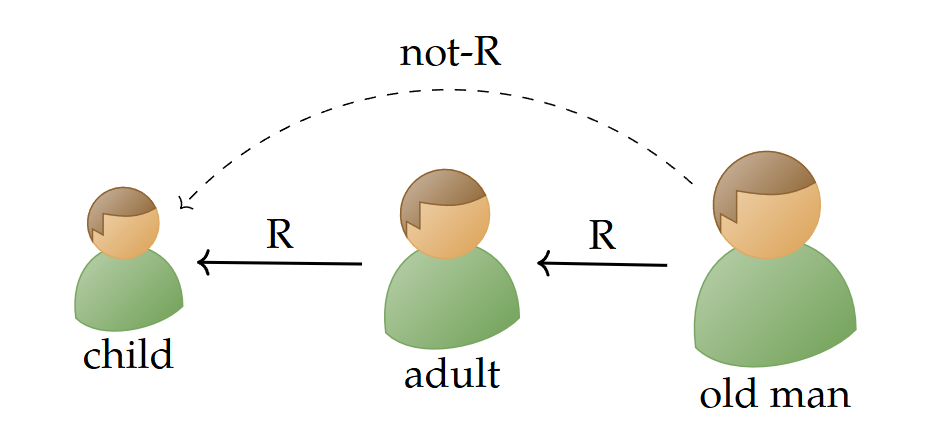
Problem: Transitivity
- \(C\) remembers \(B\) and \(B\) remembers \(A\), but
- Therefore, \(C=B\) and \(B=A\)
- By transitivity \(C=A\)
- But, \(C\) does not remember \(A\).
- Therefore, \(C\neq A\). Contradiction with (3)
Modified memory theory
flowchart RL
    A(A at t1)
    C(C at t2)
    B(B at t3)
    B e1@== remembers ==> A
    B e2@== remembers ==> C
    C e3@== remembers ==> A
    e1@{ animate: true }
    e2@{ animate: true }
    e3@{ animate: true }
Gaps problem
There are periods of time when you have no apparent non-occurrent memory of the experiences of person \(A\) but you are person \(A\).
- Blackout drunk
- Temporary brain injury
- Knocked unconscious (smelling salts not working)
Implausible results
- Suppose you awoke one day and could remember everything the biblical Noah experienced.
- Those memories were as clear in your mind as what you were doing 1s.
- MMT would say You = Noah
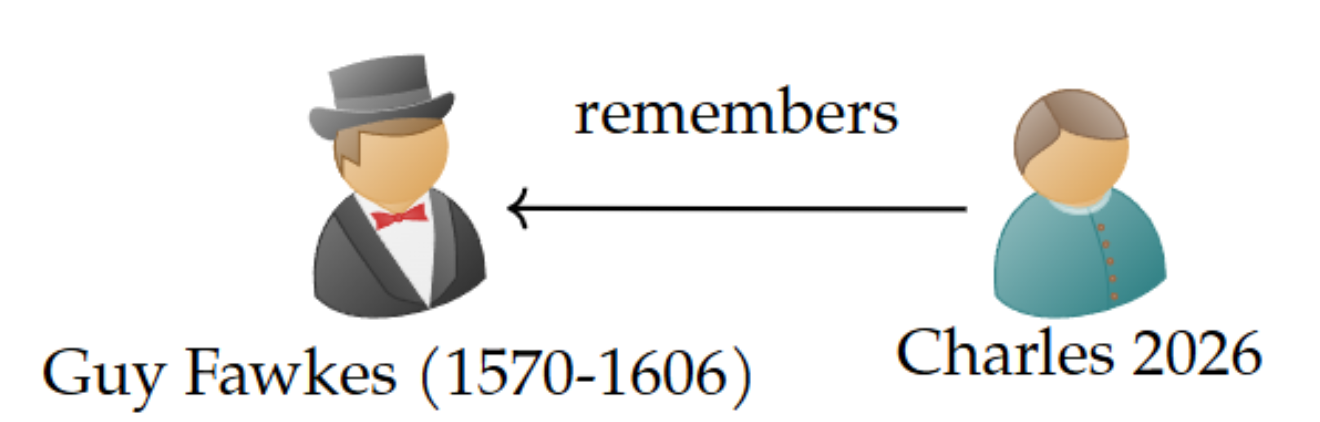
Charles is Guy Fawkes?
Suppose Charles in 2026 claims to be Guy Fawkes (1570-1606)
- Charles can apparently remember the life of Guy Fawkes
- Charles’s testimony is consistent with what we know about GF
- Charles provides additional proof, e.g., hidden secrets
Liz is Guy Fawkes?
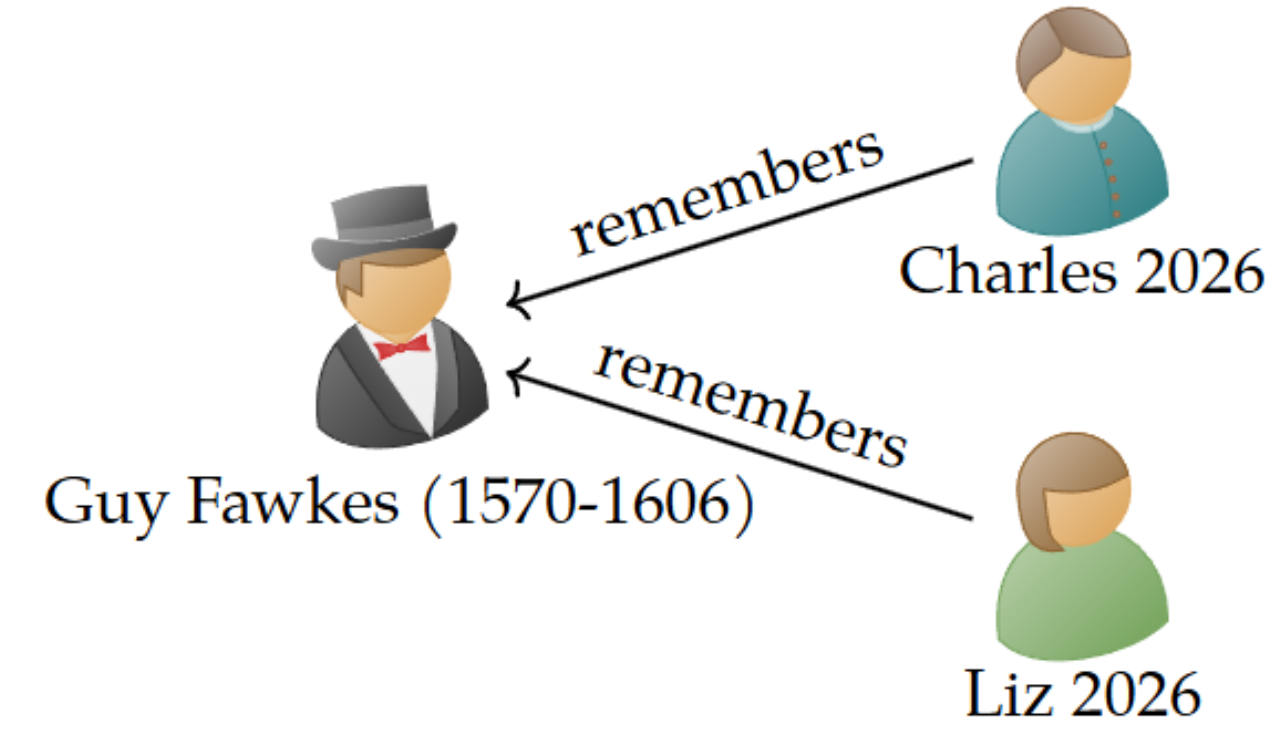
Suppose Liz claims to be Guy Fawkes (1570-1606)
- Liz can apparently remember the life of Guy Fawkes
- Liz’s testimony is consistent with what we know about GF
- Liz provides additional proof, e.g., hidden secrets
Fission Problem
- Charles = GF
- Liz = GF
- Liz \(\neq\) Charles. Contradiction
Psychological connectedness
Psychological connectedness theory
Let’s try to fix the gaps problem with a new theory.
Psychological connectedness
By psychological connectedness, we mean some weighted sum of psychological similarities or connections:
- belief continuity: \(A\) believes at \(t_1\) that Liverpool FC is the best team ever, so does \(B\) at \(t_2\).
- Trait carryover: \(A\) has sense of humor \(F\) at t1, \(B\) has sense of humor \(F\) at t2.
- Desire chains: \(A\) wants to sign up a marathon at t1, and \(B\) has this same desire at t2.
- Information retention: Person \(A\) knows X at t1 and \(B\) knows X at t2.
- belief / emotion formation: \(A\) has experience \(E\) at \(t_1\) (victim of attack) and \(B\) is fearful of the attacker at \(t_2\).
Example: Mary to Liverpool
- Mary in Chicago wants to go to Liverpool
- She buys ticket.
- Blacks out as she enters the plane.
- Arrives in Liverpool.
Psych conn = best theory?
flowchart RL
    A(A at t1)
    B(B at t2)
    C(C at t3)
    C(D at t4)
    C e1@== remembers ==> B
    B e2@== remembers ==> A
    B e2a@== psy conn ==> A
    C e3@== psy conn ==> B
    D e4@== psy conn ==> C
    e1@{ animate: true }
    e2@{ animate: true }
    e2a@{ animate: true }
    e3@{ animate: true }
    e4@{ animate: true }
- Fixes the memory gaps problem facing the modified memory theory
- Gives the intuitively correct result for brain transplants
- Gives the intuitively correct result for persons with dicephalus
- Gives the intuitively correct result for artificial brain replacement