flowchart RL
    A[A at t1]
    B[B at t2]
    B e1@== remembers ==> A
    e1@{ animate: true }
Psychological theories of diachronic identity
David W. Agler
The Pennsylvania State University
Slide commands
- Next slide: right arrow / space /
n - Previous slide: left arrow /
p - Fullscreen mode:
f - Overview mode:
o - Activate tools:
m - Activate pointer:
q - Jump to slide:
gthen type slide number
For a full list of options, see Presenting Slides
Same psychology theory
Same psychology
If A is a person at time t1 and B is a person at t2, then B is the same person as A iff B at t2 has the same psychology as A at time t1.
Problems
- Vague: what does “same psychology” mean?
- False: No core part of your psychology that stays the same
Simple memory theory
Simple memory theory
If \(A\) is a person at time \(t_1\) and \(B\) is a person at \(t_2\), then \(B\) is the same person as A iff \(B\) at \(t_2\) has the memories of the experiences of \(A\) at time \(t_1\).
Problem:
- We are not always remembering our prior selves
- We don’t have perfect memories of the past.
Revisions
Occurrent memory
An occurrent memory is a memory someone is actively having.
Non-occurrent memory
A non-occurrent (dispositional) memory is a memory someone is capable of having.
Factual memory
A factual memory is a recollection of a fact about the world.
Procedural memory
A procedural memory is a memory of how to do something.
Personal (episodic) memory
A procedural memory is a memory about (1) an experience of an event but also (2) subjective information derived from the experience of that event.
What kind of memory?
Tek is actively remembering what he did yesterday.
- Occurrent memory
- Dispositional memory
What kind of memory?
Tek could remember his locker combination but right now he is solving a Rubik’s cube.
- Occurrent memory
- Dispositional memory
What kind of memory?
Tek remembers that Harrisburg is the capital of Pennsylvania.
- Factual memory
- Procedural memory
- Personal (episodic) memory
What kind of memory?
Tek remembers that how excited he was when he was in Harrisburg.
- Factual memory
- Procedural memory
- Personal (episodic) memory
What kind of memory?
Tek is solving the Rubik’s cube.
- Factual memory
- Procedural memory
- Personal (episodic) memory
Apparent vs genuine memory
Genuine (strong) memory
Person \(A\) genuinely remembers doing event \(E\) only if \(A\) actually did \(E\).
Apparently (weak) memory
Person \(A\) apparently remembers doing event \(E\) only if \(A\) believes \(A\) did \(E\).
Identity and apparent memory
The claim that survival requires genuine memory is circular.
- \(A=B\) iff \(B\) genuinely remembers what \(A\) did.
- \(B\) genuinely remembers what \(A\) did iff \(B=A\)
flowchart RL
    R[A remembers B]
    I["A=B"]
    R <==> I
We need something that tells us when \(A=B\) but does not assume \(A=B\).
- Example: A=B iff A and B have same body
- A&B having the same body does not assume A=B
Identity and apparent memory
\(B\) having an apparent personal memory of \(A\) does not assume \(A=B\).
- Tek at t1 is the same person as Tek at t2 iff Tek at t2 believes he remembers Tek’s conscious experience at t1.
- David in 2026 is the same as David in 2013 who won a race in Tyrone, PA iff David believes himself to remember the conscious experience of winning the race.
Simple memory theory (revised)
If \(A\) is a person at time \(t_1\) and \(B\) is a person at \(t_2\), then \(B\) is the same person as A iff \(B\) at \(t_2\) has the apparent personal memories of \(A\) at time \(t_1\).
Problem: Transitivity
- \(C\) remembers \(B\) and \(B\) remembers \(A\), but
- Therefore, \(C=B\) and \(B=A\)
- By transitivity \(C=A\)
- But, \(C\) does not remember \(A\).
- Therefore, \(C\neq A\). Contradiction with (3)
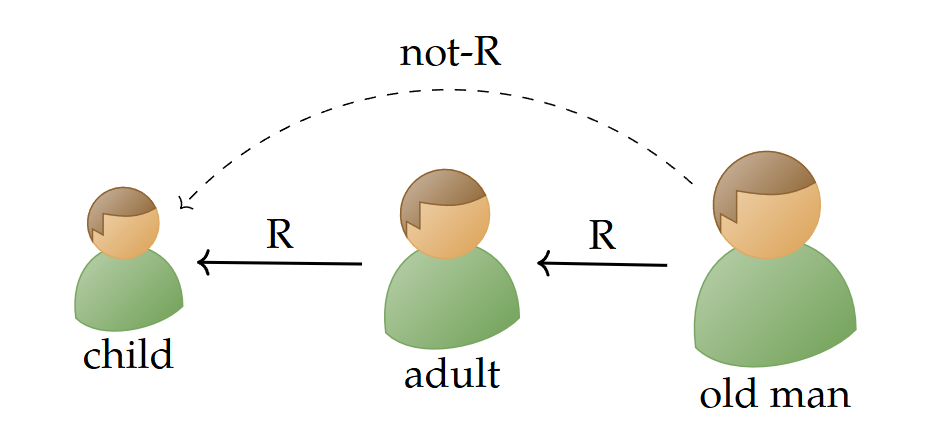
Reid’s objection
Exercise
Create your own version of Reid’s famous objection.
Modified memory theory
Modified memory theory (MMT)
If \(A\) is a person at time \(t_1\) and \(B\) is a person at \(t_3\), then \(B\) is the same person as \(A\) iff either (i) \(B\) at \(t_3\) has an apparent non-occurrent memory of an experience of \(A\) at time \(t_1\) or (ii) there is some person \(C\) at \(t_2\) such that (a) \(B\) has an apparent non-occurrent memory of the experiences of \(C\) and (b) \(C\) has an apparent non-occurrent memory of the experiences of \(A\).
flowchart RL
    A(A at t1)
    C(C at t2)
    B(B at t3)
    B e1@== remembers ==> A
    B e2@== remembers ==> C
    C e3@== remembers ==> A
    e1@{ animate: true }
    e2@{ animate: true }
    e3@{ animate: true }
Gaps problem
There are periods of time when you have no apparent non-occurrent memory of the experiences of person \(A\) but you are person \(A\).
- Blackout drunk
- Temporary brain injury
- Knocked unconscious (smelling salts not working)
Implausible results
- Suppose you awoke one day and could remember everything the biblical Noah experienced.
- Those memories were as clear in your mind as what you were doing 1s.
- MMT would say You = Noah
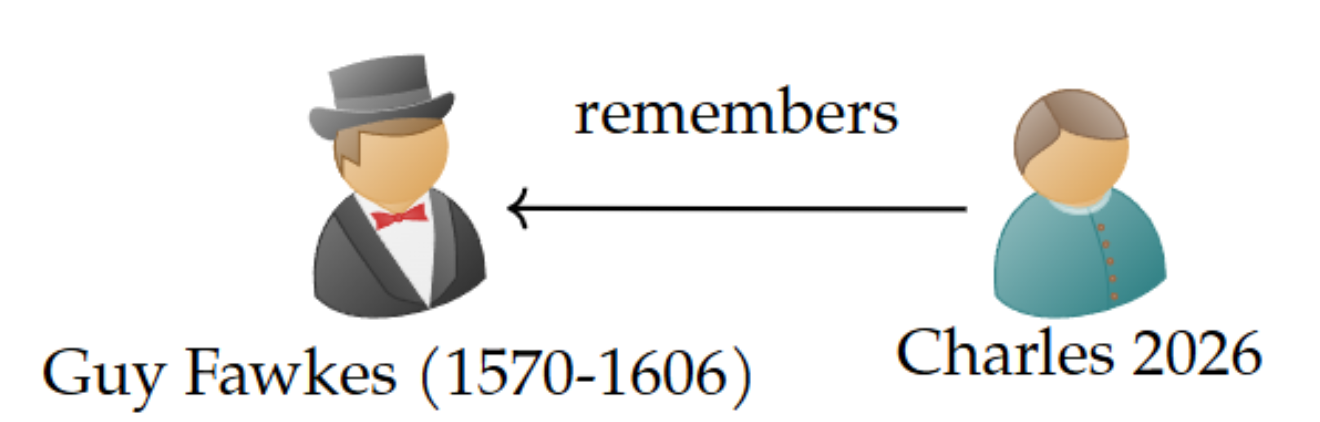
Charles is Guy Fawkes?
Suppose Charles in 2026 claims to be Guy Fawkes (1570-1606)
- Charles can apparently remember the life of Guy Fawkes
- Charles’s testimony is consistent with what we know about GF
- Charles provides additional proof, e.g., hidden secrets
Liz is Guy Fawkes?
Suppose Liz claims to be Guy Fawkes (1570-1606)
- Liz can apparently remember the life of Guy Fawkes
- Liz’s testimony is consistent with what we know about GF
- Liz provides additional proof, e.g., hidden secrets
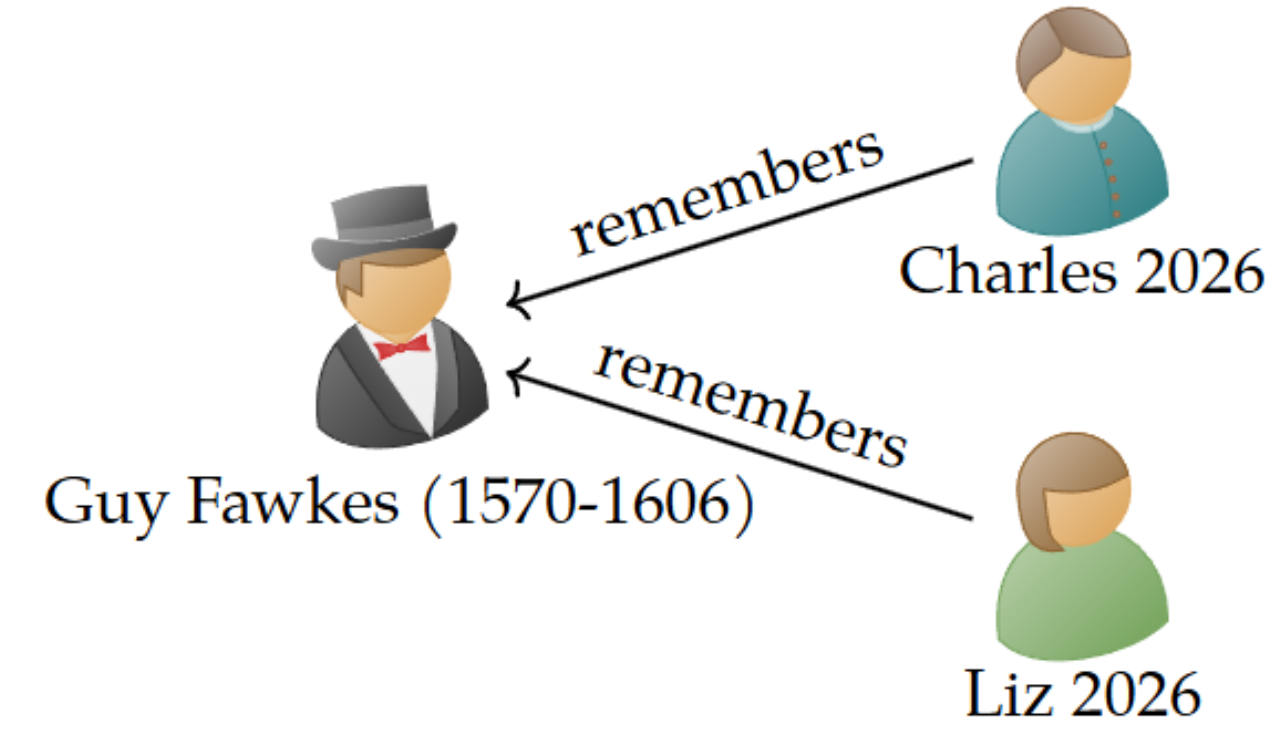
Fission Problem
- Charles = GF
- Liz = GF
- Liz \(\neq\) Charles. Contradiction
Exercise
Create your own version of the Guy Fawkes fission objection.
Psychological connectedness
Psychological connectedness theory
Let’s try to fix the gaps problem with a new theory.
Psychological Connectedness Theory
If \(A\) is a person at time \(t_1\) and \(B\) is a person at \(t_3\), then \(B\) is the same person as \(A\) iff either
- \(B\) at \(t_2\) has an apparent, non-occurrent memory of \(A\) at \(t_3\), or
- there is some person \(C\) at \(t_2\) (between \(t_1\) and \(t_3\)) such that \(B\) has an apparent, non-occurrent memory of \(C\) and \(C\) has an apparent, non-occurrent memory of \(A\), or
- there is psychological continuity between \(B\) and \(A\).
Psychological connectedness
By psychological connectedness, we mean some weighted sum of psychological similarities or connections:
- belief continuity: \(A\) believes at \(t_1\) that Liverpool FC is the best team ever, so does \(B\) at \(t_2\).
- Trait carryover: \(A\) has sense of humor \(F\) at t1, \(B\) has sense of humor \(F\) at t2.
- Desire chains: \(A\) wants to sign up a marathon at t1, and \(B\) has this same desire at t2.
- Information retention: Person \(A\) knows X at t1 and \(B\) knows X at t2.
- belief / emotion formation: \(A\) has experience \(E\) at \(t_1\) (victim of attack) and \(B\) is fearful of the attacker at \(t_2\).
Example: Mary to Liverpool
- Mary in Chicago wants to go to Liverpool
- She buys ticket.
- Blacks out as she enters the plane.
- Arrives in Liverpool.
Psychological Connectedness Theory
Intuitively, Mary in Liverpool is the same person as the person in the plane as the person in Chicago even though there is a memory gap.
Psych conn = best theory?
flowchart RL
    A(A at t1)
    B(B at t2)
    C(C at t3)
    C(D at t4)
    C e1@== remembers ==> B
    B e2@== remembers ==> A
    B e2a@== psy conn ==> A
    C e3@== psy conn ==> B
    D e4@== psy conn ==> C
    e1@{ animate: true }
    e2@{ animate: true }
    e2a@{ animate: true }
    e3@{ animate: true }
    e4@{ animate: true }
- Fixes the memory gaps problem facing the modified memory theory
- Gives the intuitively correct result for brain transplants
- Gives the intuitively correct result for persons with dicephalus
- Gives the intuitively correct result for artificial brain replacement
Objections to the psychological connectedness theory
Teletransportation
Suppose you are offered a free trip in the teletransportation device.
flowchart LR
    A[Tek at t1]
    B[Teletransporter]
    C(Tek? at t2?)
    A e1@== enters ==> B
    B e2@== exits ==> C
    e1@{ animate: true }
    e2@{ animate: true }
Teletransportation details
- Scan of brain and body
- Data sent to intended destination
- Fall asleep
- Body reconstructed in intended destination
- Old body destroyed after new body wakes up.
Psychologically
- Stand in machine
- Close eyes
- Wake up in new location
- Retain all of your memories
- Feels like closing your eyes for a split second.
What does the theory say?
- Psychological connection between \(A\) and \(B\), so \(A=B\).
- Psy theory: you would survive teletransportation.
Exercise
Would you use the teletransporter?
Fission
flowchart LR
    C[Tek at Chicago]
    T[Teletransporter]
    P(Tek? in Paris)
    V(Tek? in Vegas)
    C e1@== enters ==> T
    T e2@== exits ==> P
    T e3@== exits ==> V
    e1@{ animate: true }
    e2@{ animate: true }
    e3@{ animate: true }
- Tek-P = Tek-C
- Tek-V = Tek-C
- Therefore, Tek-P = Tek-V (transitivity)
- But, Tek-P\(\neq\) Tek-V.
Teletransportation device
Exercise
- Draw a scenario where the teletransportation device results in fission, e.g., who is entering the machine, where are they going?
- What would be a practical consequence of fission, e.g., money is split in bank account?
Five solutions
- Pick one: Tek-P is the real one.
- Pick one: Tek-V is the real one.
- Neither one: neither Tek-P nor Tek-V are Tek-C
- Both: Tek-P = Tek-V = Tek-C
- No answer.
Pick one
- Both of these solutions are completely arbitrary.
- No reason to pick one over the other.
Neither one
Two reasons to accept.
- R1: Teletransportation is death.
- R2: People survive teletransportation but not when fission occurs.
R1: Death machine?
The problem with saying teletransportation (TT) is death is that there is no psychological difference between these two cases:
- Tek-C falls asleep in airport and wakes up
- Tek-C enters TT and wakes up in Paris.
Psy theory needs to say what is the psychological difference. Physical theory might say that teletransportation results in death because of non-continuity of body.
R2: If fission, no identity
non-branching condition
If \(A\) is a person at time \(t_1\) and \(B\) is a person at \(t_2\), then \(B=A\) iff there is psychological continuity between \(B\) and \(A\) and there is no other person \(C\) who is psychologically continuous with \(A\) at \(t_2\).
Problems with R2
- Ad hoc: no reason why you shouldn’t survive fission.
- Violates only x and y principle
Only x and y principle
only x and y principle
Whether a later individual, \(y\), is numerical identical to an earlier individual, \(x\), only depends upon facts about \(x\) and \(y\) and the relations between them (it does not depend upon facts about some other individual \(c\))..
Examples
- If \(x\) is Superman at \(t_1\) is \(y\) is Clark Kent at \(t_2\), then Superman = Clark Kent depends upon these two individuals, not some other individual “John”.
- Whether my body survive the replacement of my arm depends my body at two separate stages, not what is going on in some other part of the world.
Both - Problems
- A person cannot be wholly located in two distinct places at once (Paris and Vegas).
- A person knows what they are thinking / experiencing, but Tek-P and Tek-V don’t know what the other is thinking / experiencing.
- If Tek-P dies, Tek-V survives. Strange to say that part of Tek died.
- Tek-P and Tek-V might fail to recognize themselves.
No answer
“If all the possible answers are implausible, it is hard to decide which of them is true, and hard even to keep the belief that one of them must be true. If we give up this belief, as I think we should, these problems disappear.”
Many unsolved problems:
- Vagueness problem (tallest short person)
- Maybe God’s existence
- Millennium Prize Problems
Problem 1: Ostrich
“If all the possible answers are implausible, it is hard to decide which of them is true, and hard even to keep the belief that one of them must be true. If we give up this belief, as I think we should, these problems disappear.”
Yes, all problems “go away” if you just ignore them.
Problem 2: Unknowable vs. unknown
No solution vs. solution exists but it is not known.
- Comte (1830s): Humans will never know the makeup of stars (later discovered via spectroscopy)
- Mach (atoms): Cannot be known because they cannot be observed
- Gleason’s theorem: math theorem thought to be unprovable constructively, later there was a constructive proof (Richman, Bridges)
Three more solutions
- Gradual separation: both, then …
- Reject reduplication
- Reject psychological approach
Gradual separation
Some people say that
- at \(t_2\) Tek-C = Tek-P = Tek-V, but
- at \(t_3\) Tek-P \(\neq\) Tek-V
OK, but
- at \(t_3\), is Tek-C = Tek-P?
- at \(t_3\), is Tek-C = Tek-V?+
Reject reduplication
Claim is that reduplication is impossible.
- Practically impossible? Maybe.
- Technologically impossible? No.
- Metaphysically impossible? No.
Reject psychological approach
Order we discussed theories:
flowchart LR
    S(Soul)
    Phy[Physical]
    Psy[Psychological]
    S ==> Phy
    Phy ==> Psy
Where to go now?
flowchart LR
    S(Soul)
    Phy[Physical]
    Psy[Psychological]
    New["New theory?"]
    Up["Give up"]
    S ==> Phy
    Phy ==> Psy
    Psy ==> Phy
    Psy ==> S
    Psy ==> New
    Psy ==> Up
Exercise
Is there a solution to the teletransportation problem?