Physicalist theories of diachronic identity
Physicalist Theories
Same body theory
- You at t1 and me at t2 are different people because we have different bodies.
- David at t2 is the same as David at t1 because he has the same body
Objection: Same body?
What do we mean by “having the same body”?
- Not: qualitatively identical bodies because bodies change
- Not: some singular part that stays absolutely constant
Common response
Some argue that there is some physical part of you that remains unchanged throughout your life.
Common responses: Neurons
- Scientists thought the number of neurons were fixed.
- In the 1960-1980 it was discovered that new neurons formed in the hippocampus
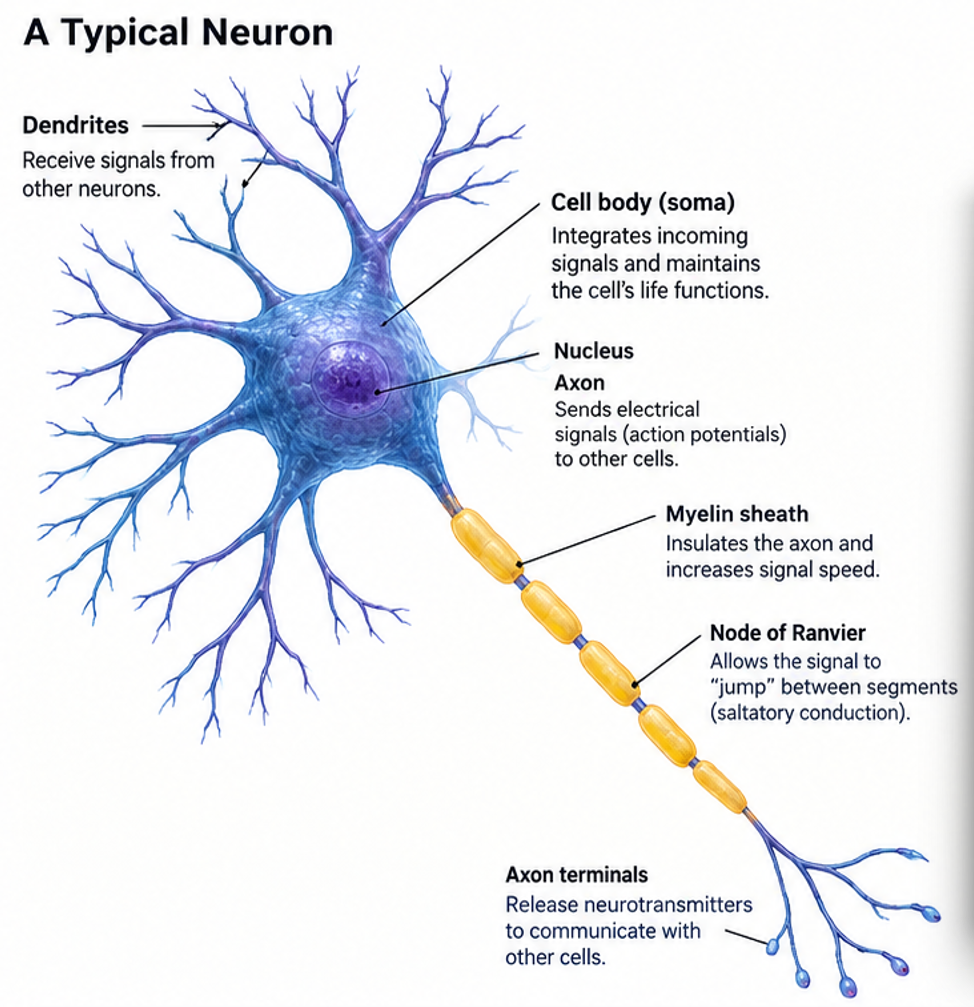
Death of neurons
While neurons are longest living cells of body, they die as we age, are injured, or diseased (Parksinon’s Huntington’s, Alzheimer’s).
They Change
- Change at the atomic level: take in Oxygen, glucose, amino acids, push out waste
- Molecules breakdown and are rebuilt
- Axon terminals contain synapses w/ receptors. Learning increases the number of receptors.
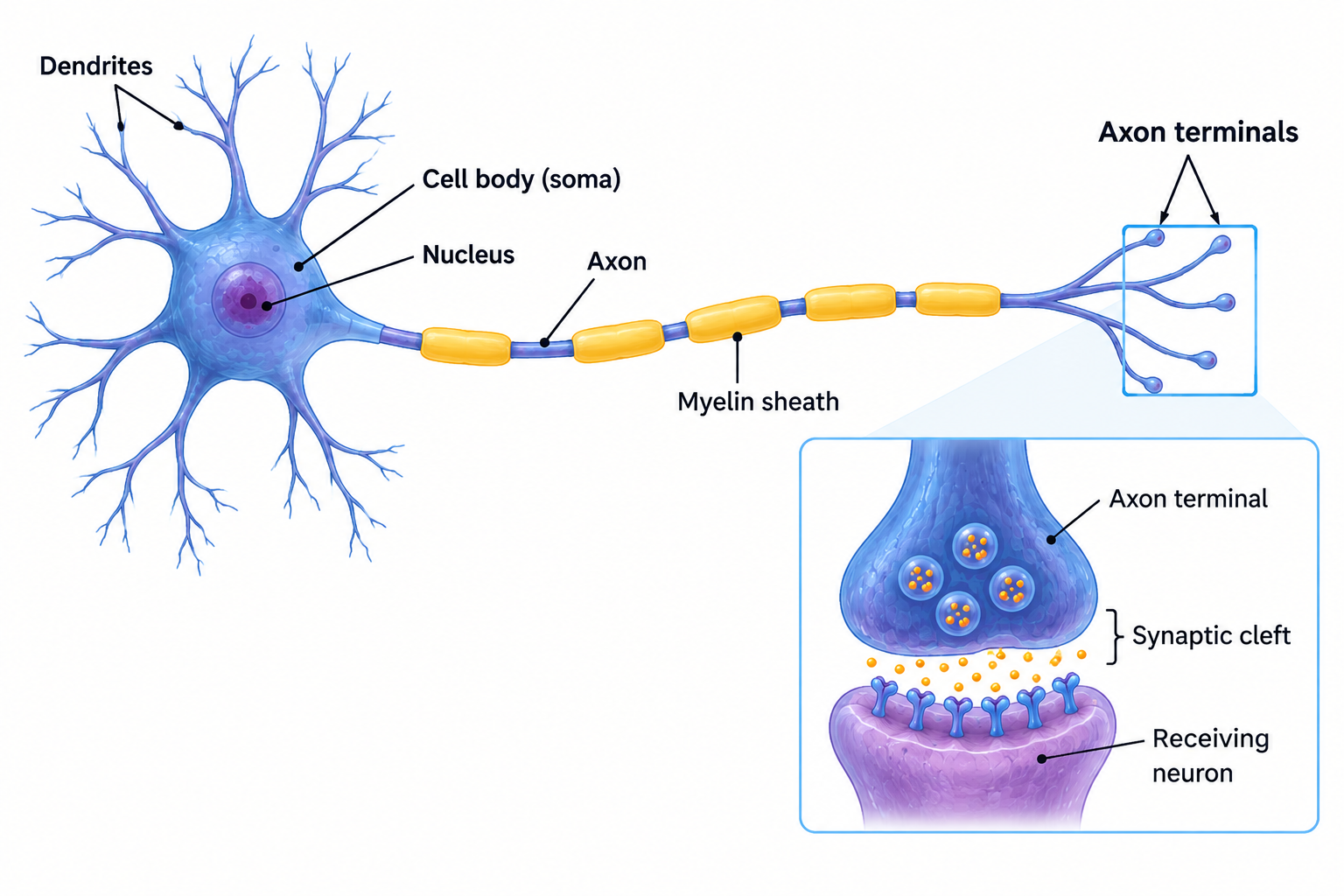
Common responses: Eyes
Size of the eye might not change much, but …
- They undergo protein turnover, DNA repair, membrane replacement, metabolic changes, molecular maintenance, etc.
- Irrelevant: You would still be you if you lost your eyes
Eye Lenses
The lens of the eye has minimal change:
- Many lens fiber cells persist throughout your lifetime
- New lens cell fibers are added ontop of old ones
- Proteins inside these cells are long-lived
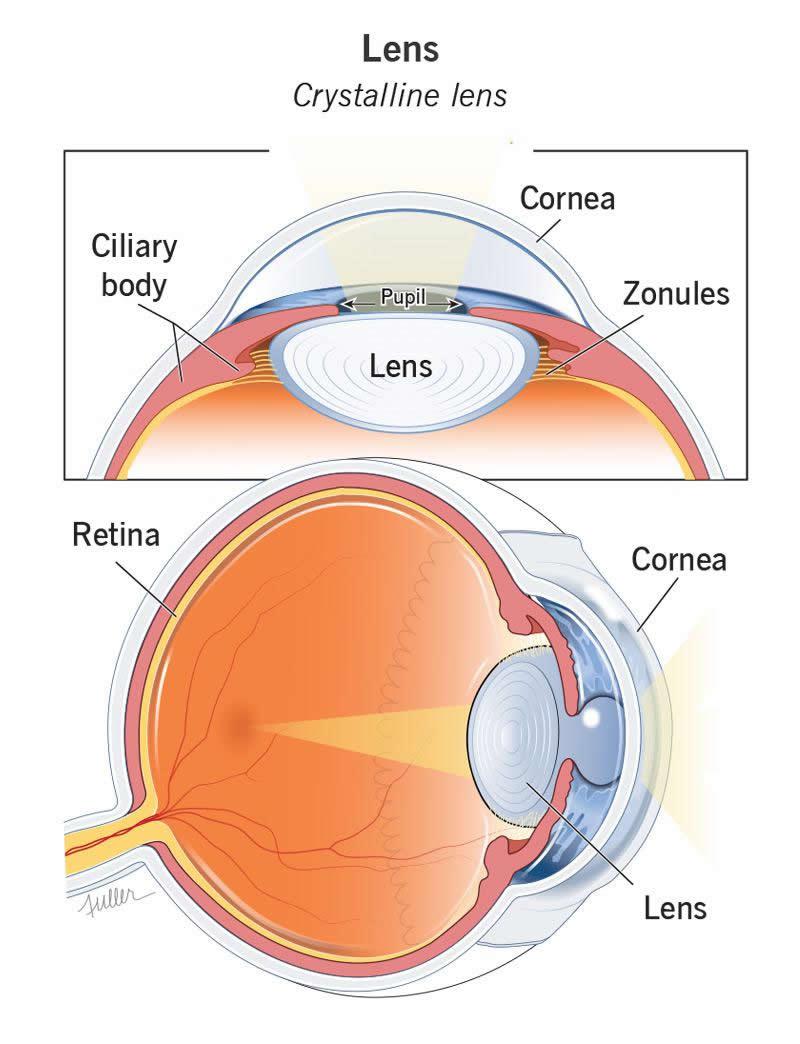
Eye Lens
- Proteins inside the eyes undergo various modifications, e.g., oxidation, molecular change
- Even if they didn’t change, you would still be you if you lost the lenses of your eyes (intraocular lens (IOL) replacement)
Common responses: Tooth enamel
- Most of your tooth enamel is just minerals (no living cells)
- The cells that produce tooth enamel (ameloblasts) are lost after you gain a tooth.
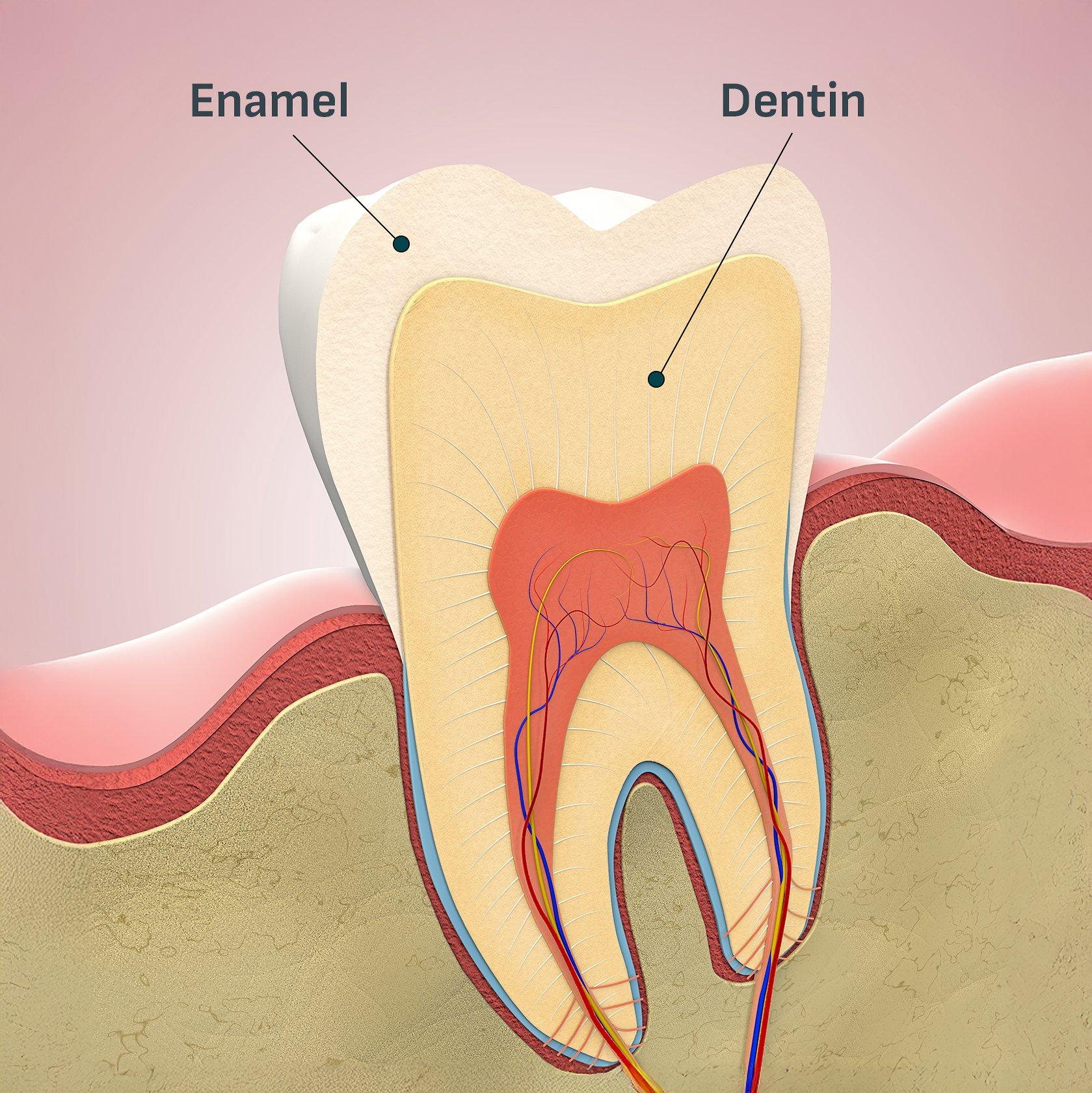
Objections: Tooth enamel
- You didn’t become you once you gained your adult teeth.
- You don’t die after you lose the enamel on your teeth
Having the same body
- “Having the same body” \(\neq\) unchanging material part
- Having the same body must accommodate change.
Exercise
- replacement of an old skin cell with a new skin cell (part replacement)
- loss of an arm (loss of part)
- replacement of an arm with a robotic arm
- Gradual replacement of 49% of your human cells through natural growth and decay
- Rapid replacement of 100% of your human cells with different human cells
- Gradual Replacement of 99% of your human cells and parts with donkey cells and parts
- Complete destruction of your body and construction of “new you” with totally new parts
Biological theory
Three conditions
- Spatiotemporal continuity
- Same kind of thing
- Gradual change
Spatiotemporal continuity
- Intuition: body \(A\) at t1 and body \(B\) at t2 are the same bodies if there is a continuous physical connection between \(A\) to \(B\).
- We can draw a path in spacetime.
Implication: If a person materialized in this room and looked exactly like you, they would be an imposter.
Same kind of thing
You have a new body if you change the kind of body you have.
- Human \(\to\) Dolphin. Death
- Human \(\to\) Donkey. Death
Gradual change
Intuition that you cannot survive rapid, full body replacement.
- All of my body parts replaced in 1s \(\to\) New Body. Death.
Biological theory
- All three are necessary requirements
- Together they are sufficient.
Argument from Language
- P1: Our language tracks reality.
- P2: When we talk about ourselves as persisting, we express it in terms of our body persisting.
- C: Therefore, we are just our bodies persisting through time.
Examples
- If I walk to the store, I am talking about my body walking to the store.
- If you ask me where I was yesterday, I give you the location of my body.
Argument from Grounding
- Our physical states are more fundamental than our psychological states (the latter are grounded in the former)
- Proof: For any psychological state (e.g., pain) there is a corresponding physical state (brain state), but not necessarily vice versa.
- Therefore, fundamentally, we are nothing but our bodies existing through time.
Simple Fetus Argument
- P1: You are a person now.
- P2: You were once a fetus.
- IC: Therefore, the person you are now is numerically identical to that fetus.
- P3: There is no psychological connection between you and the fetus.
- P4: There is a biological connection between you and the fetus.
- C: Therefore, you are just your body.
Simple Fetus Argument (Continued)
Mad Scientist Argument
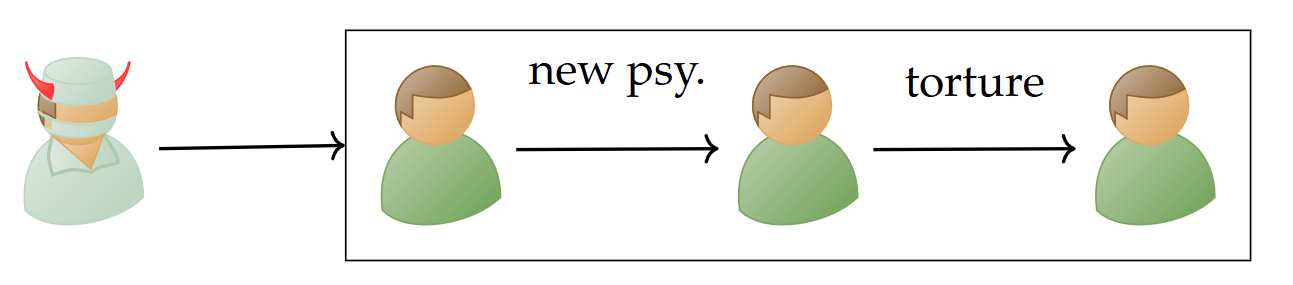
- You are kidnapped
- Your body has your psychology removed
- It is replaced with a new psychology
- Your body is now tortured.
Mad Scientist (Continued)
Continued
- You are kidnapped
- Your body has your psychology removed
- It is replaced with a new psychology
- Your body is now tortured.
If step (4) is causing you personal concern, it indicates that you consider yourself to be your body.
Arguments against the biological theory
Rapid Change
Bio theory says change must be gradual.
Rapid change 1
I can survive these:
- Tattoos and piercings
- Cosmetic implants: breast / calf implants, subdermal horns, facial fillers
- Alterations: tongue bifurcation, earlobe stretching, neck elongation, tooth filings, ear pointing (elfin ears)
- Scarification or branding
- Organ Transplants: kidney transplant, pace maker
- Neural implants: cochlear implants, neuralink
Rapid change 2
I cannot survive rapid replace of every organ (heart, liver, kidney, brain), bone, and fluids (blood)
Response
I survive iff:
- the change is gradual, OR
- when the change is rapid, there is no significant modification to the “essential” body parts
Problem: Brain transplants
- I can survive the loss of an arm.
- I can survive the replacement of an arm with a new arm.
Can I survive the replacement of any single body part?
Brain transplants
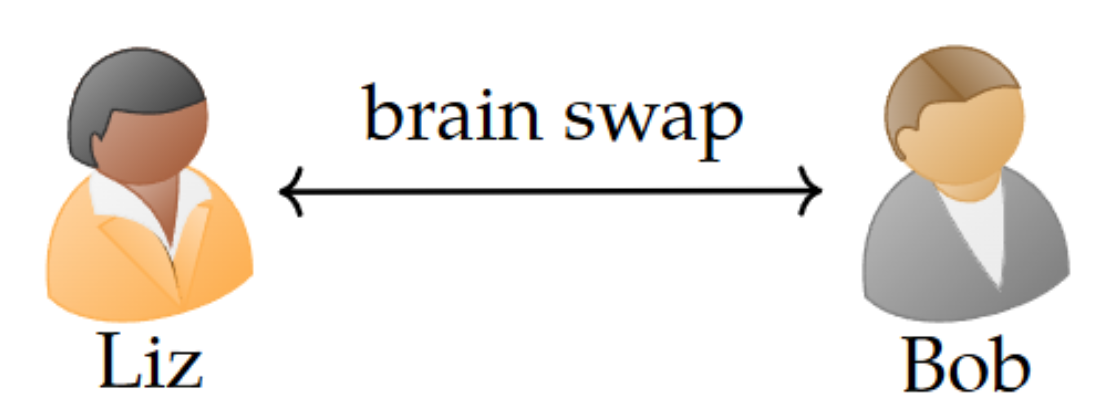
- Suppose Bob and Liz swap brains.
- Where does Bob go?
- Where does Liz go?
Answers
- Answer 1: Only one organ was replaced. Bob is still in Bob’s body. He just has a new brain.
- Answer 2: Brain priority. Bob is now in Liz’s body. He has a new body.
- Answer 3: Both dead.
Dicephalic parapagus
- Dicephalic parapagus (two heads, one torso) is extremely rare (1 in 100,000)
- Even more rare is survival after birth.
- Abigail Hensel and Brittany Hensel (separate and shared control of the body)
- Elementary school teachers
Same body theory
- Bio theory: there is one body. Therefore, one person.
- There are clearly two people.
- Therefore, the bio theory is wrong.
Same brain theory
The good
- No worries about rapid replacement of arms, legs, tattoos, etc. (brain is essential body part)
- We go where our brain goes (solves transplant problem)
- Dicephalic parapagus involves two people (not one)
Problem: Fetus problem
Bio theory was attractive because it makes us identical to the human fetus.
- You are now a person
- You are identical to anyone who has your brain.
- Early fetus does not have a brain.
- Therefore, you never were a fetus.
Problem: Hemispherectomy
- You could survive a full brain transplant
- People survive corpus callosotomies (separation of the two hemispheres)
- People survive hemispherectomies (removal of one of the hemispheres)
Yearly checkup
- You get a routine checkup
- Disease in your left hemisphere.
Dr. Tex recommedation: hemispherectomy and transplantation of left hemisphere into new body.
Fission
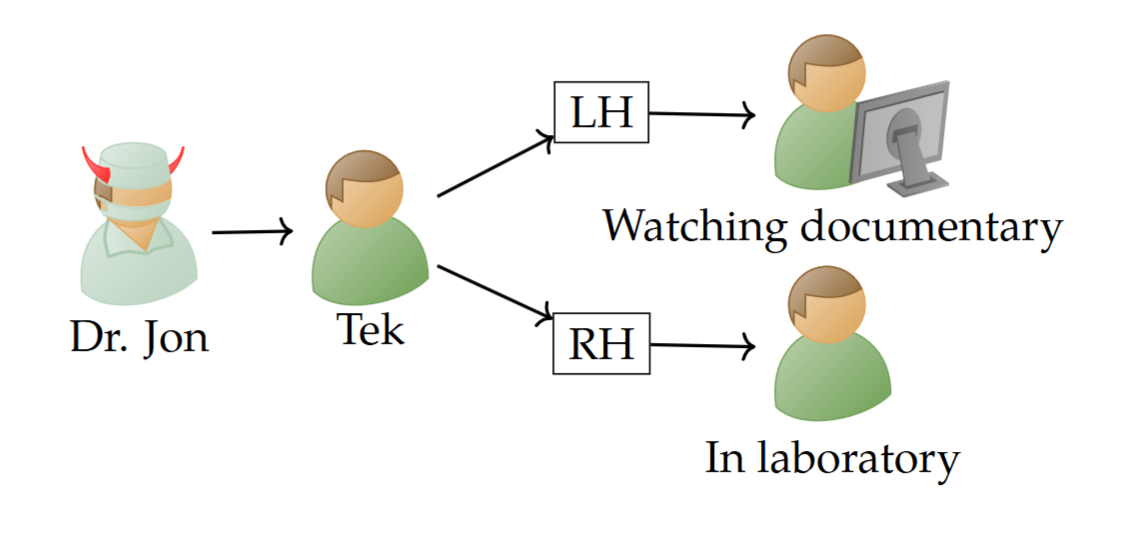
- Tek = LH
- Tek = RH
- Therefore, LH = RH (transitivity)
- But, LH \(\neq\) RH. Contradiction!
Brain modification
Artificial brain
One condition of brain theory: \(A\) = brain \(B\) iff the same kind of brain (human).
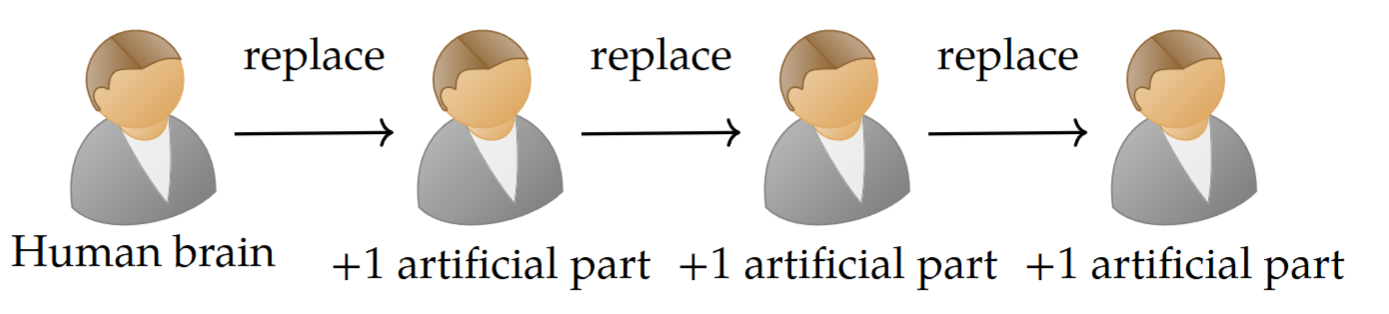
- End of the process, you have an artifical brain (not human brain).
- Conclusion: you don’t need to have the same kind of brain.
Spatiotemporal continuity
- Your brain has an infection. You will die in days.
- Scan your current brain in every detail.
- You receive anesthesia and fall asleep
New Brain
You wake up and remember:
- Being told you had a brain infection
- Being told you would die
- Having your brain scanned
- Receiving anesthesia and falling asleep.
New Brain
But, you have a new brain!
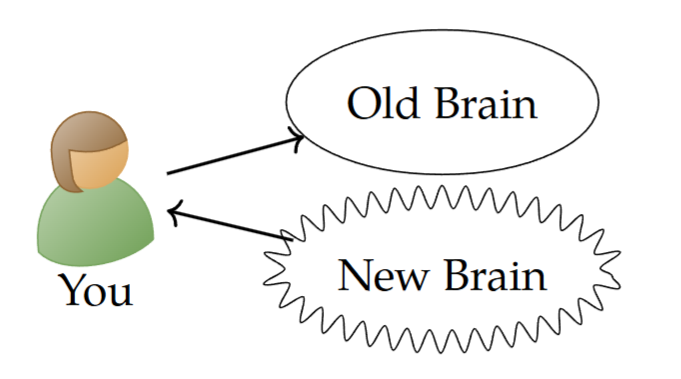
- Conclusion: Survival does not require spatiotemporal contintuity of the brain.
Body swapping
- Mad scientist takes two people: Alice and Bob.
- He plans to swap the minds of Alice and Bob.
So,
- The mind of Alice is put into Bob’s body.
- The mind of Bob is put into Alice’s body.
Body swapping torture
Before the procedure, Bob is asked:
After the procedure, which body would you like to be tortured and which body would you like to be set free and receive ten million dollars?
Presumably, Bob will say:
“I want the Bob-body to be tortured and I want the Alice-body to receive the freedom and money.”
Body swapping torture
- This suggests that you go where your mind goes.
- Survival does not require spatiotemporal continuity.
Same brain theory
Problems:
- No spatiotemporal continuity: brain replacement, psy. swap.
- No same kind: artificial brain replacement
- Fission problems: even when we meet all the conditions, we get a contradiction in fission cases.