What is a theory of time?
David W. Agler
The Pennsylvania State University
Working definitions
A time
Definition
A time is what corresponds to a complete and consistent specification (snapshot, description, picture, account) of a world.
Clarifications
- Time just is the world at an instant (complete)
- It is consistent in that there are no contradictions: (1) and (2) can happen but at two different times
- Tek is in NYC
- Tek is in State College
- If nothing corresponds to the description “that time does not exist.”
- Does not assume linearity or directionality.
Three subtheories
Three subtheories
A theory of time is made of three parts (or three subtheories)
- Theory of temporal ordering
- Theory of temporal ontology
- Theory of temporal passage
Temporal ordering
A set does not have order (unordered collection of unique objects)
\[A = \{3, 2, 1\}, \{2, 3, 1\}\]
- The times of our world are assumed to have some order and so times have position relative to other times.
- The ordering and position is said to be an objective feature of the world.
Time as a dimension
A dimension refers to the number of coordinates needed to specify a point (something).
- Space is said to have three dimension (x, y, z)
- Time has one.
- We can put times on a line.
This is why we talk about a timeline.
How are events ordered?
There are two main ways that events are said to be temporally ordered.
- A series
- B series
A Series
Take a horizontal line and specify a point on that line (e.g., 0).

We can specify the position of other points from how far they are from this line.
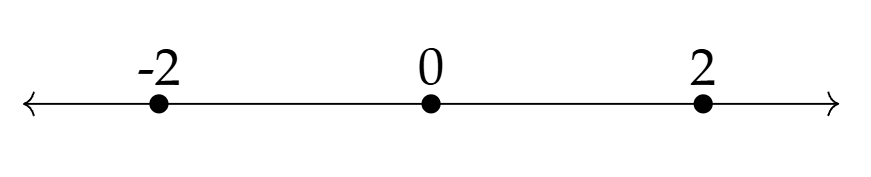
Continued
Times can be ordered in the same way. Take a special time: the Present

We can specify the position of other times from how far they are from the present (e.g., two days from the present, or two days past).

A Series and the world
This is one picture of the temporal ordering of the world
- Special moment in time: the present
- Other events are ordered in terms of their distance from this time.
Definition
The A-series structures time in terms of the objective past, present, and future
Clarifications
There is a single present moment.
- Assume there are multiple presents.
- If they occur at the same time, then they are the same time (same present)
- If they are different times, then one is earlier / later than the other, and so it is not the present.
B Series
The B-series says time is ordered in terms of relations:
- t1 is earlier than t2
- t2 is later than t1
- t1 is occurring at the same time (relative to the inertial frame) as t2
Definition
The B-series structures time in terms of earlier than, later than, simultaneous with
Clarification
The B-series
- does not order times in terms of the present, past, or future
- does order time in terms of relations between times that exist
Temporal ordering and our world
- Our world consists of events (times)
- These events are ordered (have position)
- The order of these events (times) distinguishes our world from others
Exercise
Consider point (3) by imagining that the order of events in our world was different. That is, consider some historical event (or event in your life) and move its temporal position, e.g., from distant past to near past, or from future to past.
A theory and B theory
A theory and B theory
We have two ways of ordering our world:
- A series
- B series
Now let’s consider two theories of temporal ordering:
- A theory
- B theory
A theory and B theory
A-theory
The world is ordered by the A-series and B-series
- Events really are past, present, and future.
- Events really are earlier than, later than, simultaneous with others
B theory
B-theory
The world is only ordered by B-series
- Events really are earlier than, later than, simultaneous with others
- No events really are past, present, and future.
Which are you? - Exercise
Exercise
Are you an A-theorist or B-theorist?
Temporal ontology
Temporal ontology
- Theory of temporal ontology specifies the times (events) that exist.
There are three main theories:
- Presentist
- Past-presentist
- Eternalist (permanentist)
Presentist
Definition
The presentist theory of temporal ontology states that only present times (events) exist.
- Reality is exhausted by what exists in the present
- Only present events are objectively real
- An object exists in time if and only if it is in the present moment.
Examples
What exists is coextensive with what is in the present.
Example:
- You and I are in the present (and we exist)
Objects in the past do not exist simpliciter
- George Washington did exist
- My daughter’s daughter will exist.
Eternalist
Definition
The eternalist theory of ontology says that all events in time exist in the same way (also called “permanentism” and “event everywhereism”)
- Everything that ever existed, exists, or will exist exists eternally.
- Whether something exists right now does not matter to whether it exists.
- If the world began in 0 AD and ends in 3000 AD, then each event between 0 and 3000 AD exists in the same way.
Example
Suppose this is your life:
The eternalist says all of these events exist.
Spatializers
Someone who accepts eternalist-TO is sometimes called a “spatializer” because time is analogous to space.
- US Route 66 runs from Chicago to Santa Monica
- There is the beginning section, the middle section, and the end section
- All of these sections exist.
This is just like your life
Book example
A book is divided into chapters.
- This is like your life
- Beginning stage (chapters 1-5)
- Middle stage (chapters 6-10)
- End stage (chapters 11-15)
Past-Presentist
Definition
Past-presentist theory of temporal ontology states that only past and present events exist.
- Reality is exhausted by what exists in the past and the present
- Past and present events are objectively real
- Whether or not an event exists depends upon its position in time since only past and present events exist.
Examples
- George Washington eating an apple (in 1776).
- The event that is happening right now (the present).
- You are sitting in jail (in 2030).
Events (1) and (2) exist in the same way you and I exist (simpliciter), but (3) only exists with qualification.
Which are you? - Exercise
Which are you? Presentist, Eternalist, or Past-presentist?
Temporal passage
- A theory of temporal passage gives an account of whether time passes
- Generally, theories accept that time does not pass unless there is change.
- So, theory states whether there is change in the world
Dynamic vs. static
- Dynamic answers: Yes, there is change (time does pass)
- Static answers: No, there is change (time does not pass)
Challenges:
- Dynamic theories: state the type of change in the world
- Static theories: explain why there is no change even though it seems like there is.
Dynamic theories
Two main versions:
- Property change dynamic theory
- Ontological change dynamic theory
Both theories contend that change is a part of objective reality (not an illusion, not due to how we experience what exists).
Property change
Property change dynamic theory of temporal passage
- There is real change in the world.
- Change comes about by events changing their temporal properties (being past, being present, being future)
- The passage of time is a change to a time’s temporal properties
Example
Event: You dancing in the club.
- The event has the property of being future.
- The event loses this property and gains the temporal property of being present
- The event loses this property and gains the temporal property of being past
Clarification
On this theory of temporal passage, nothing ever changes other than an event’s temporal properties
- new objects are not created or destroyed
- objects don’t gain or lose traits
The only change that occurs is the gain / loss of temporal properties
Ontological change
ontological change dynamic theory of temporal passage
- There is real change in the world.
- Change comes about through objects coming in (or going out) of existence (ontological change) or those objects gaining or losing certain properties that are not purely temporal properties.
- The passage of time is this coming in (or going out) of existence (ontological change)
Examples
Example 1: New object
- The world does not have Tek in it.
- Tek is born (new object added to the total stuff of the world).
Example 2: New property
- Tek is out of shape
- Tek starts lifting (gains property of being strong; loses property of being weak).
Clarification
The flow of time is explained in terms of
- New objects coming in or old objects going out
- Properties being added or removed
Consequence: Time does not flow in an frozen universe (against Newton’s absolutist view of time)
Static theory
static theory of temporal passage
- There is no change in the world (this is a perspectival fact)
- Real change does not occur either by times gaining or losing temporal properties or by new times coming into or going out of existence (no property or ontological change)
- Time does not pass! There is no moving present.
Which are you? - Exercise
Which are you? Static theory, dynamic ontological, or dynamic property theorist?
Four theories of time
Four theories of time
| Theory | A or B | Temp. ontology | Temp. passage |
|---|---|---|---|
| Eternalist | B | eternalist | static |
| Presentist | A | presentist | dynamic (ontological) |
| Growing Block | A | past-presentist | dynamic (ontological) |
| Moving Spotlight | A | eternalist | dynamic (property) |