flowchart TD
    T["Truth table"] --> w["wff"]
    T["Truth table"] --> s["set of wffs"]
    T["Truth table"] --> a["argument"]
    w --> c["contradiction, tautology, or contingency"]
    s --> i["consistent or not"]
    s --> e["equivalent or not"]
    a --> v["valid or invalid"]
CH3 – Slides
Slides / handouts are available on my website
PL: Truth Tables
Informal Test: Example
- P1. Some basketball players are millionaires.
- P2. Some millionaires have fancy cars.
- C. Therefore, some basketball players have fancy cars.
90% will say “valid” but it is invalid.
Informal Test: Example 2
- P1. If my car is out of gas, then it won’t start.
- P2. My car won’t start.
- C. Therefore, it is out of gas.
Many will say “valid” but it is invalid.
Informal tests
Informal tests (logical intuition, logical imagination) have problems
- Wrong or inconsistent results
- Belief bias: true conclusion therefore valid argument.
- Large arguments
- Abstract content
We want a test that …
- gives consistent results
- tests validity without belief bias
- can be applied to large arguments
- can be formulated about any subject matter
What is a truth table?
Definition
A truth table for PL is a table that provides a graphical way of representing valuations of wff(s) under a set of interpretations.
Basic Idea
Use a truth table to check if the premises are T and conclusion is F.
We’ve used truth tables already
\[ \begin{array}{c|c} \phi & \neg (\phi)\\ \hline T & F\\ F & T \end{array} \]
\[ \begin{array}{c c|c c c c} \phi&\psi&\phi\wedge \psi&\phi\vee \psi&\phi \to \psi&\phi\leftrightarrow \psi\\ \hline T&T&T&T&T&T\\ T&F&F&T&F&F\\ F&T&F&T&T&F\\ F&F&F&F&T&T \end{array} \]
Using table to test arguments
- Gives consistent results
- Finite mechanical method (no bias)
- Works on large arguments
- Works on any subject matter
- “Is the argument valid?” Always gives “yes” or “no” answer
The plan.
- Use tables to determine T-value of any wff (under single interpretation)
- Use tables to determine T-value of any wff (under every interpretation)
- Use table as a tool to check validity (and other stuff)
Truth Tables: Step by Step
- Write down the wff.
- Write the truth value (\(T\) or \(F\)) under each propositional letter in the wff for each interpretation \(\mathscr{I}\).
- Assign \(T\) or \(F\) to subformulas in the order that the wff is constructed using (1) the values assigned to the subformulas used to construct that wff and (2) the valuation function assigned to the operator added to the subformula constructed.
Step 3?
Step 3 is precise but not intuitive.
Step 1
Let’s create a truth table for this wff: \(P\land \neg Q\)
- Step 1: Write down the wff with each propositional to the left of it
\[ \begin{array}{c c|c c c c} P&Q &P& \land & \neg & Q\\\hline & & & & \\ \end{array} \]
Step 2
Step 2: Get an interpretation of the propositional letters and write it under the letters. - Let \(\mathscr{I}(P)=T\) and \(\mathscr{I}(Q)=F\).
\[ \begin{array}{c c|c c c c} P&Q &P& \land & \neg & Q\\\hline T&F & & & \\ \end{array} \]
write the T-values under the letters of \(P\land \neg Q\).
\[ \begin{array}{c c|c c c c} P&Q &P& \land & \neg & Q\\\hline T&F &T & & &F\\ \end{array} \]
Step 3.1: Calculate the truth table
- Step 3.1: Construct the formula using formation rules.
\[ \begin{array}{c c|c c c c} P&Q &P& \land & \neg & Q\\\hline T&F &T & & &F\\ \end{array} \]
- \(P, Q\) are wffs.
- If \(Q\) is a wff, then \(\neg Q\) is a wff.
- If \(P\) and \(\neg Q\) are wffs, then \(P\land \neg Q\) is a wff.
Order of calcuation
We will calculate the T-value of \(P\land\lnot Q\) in this order.
Step 3.2: Calculate the truth table
Assign truth values to the subformulas in the order in which you constructed the formula
- Assign T-values to \(P\) and \(Q\). DONE!
- Assign T-value to \(\neg Q\)
- Assign T-value to \(P\land \neg Q\)
\[ \begin{array}{c c|c c c c} P&Q &P& \land & \neg & Q\\\hline T&F &T & & &F\\ \end{array} \]
Truth Tables for the Operators
\[ \begin{array}{c|c} \phi & \neg (\phi)\\ \hline T & F\\ F & T \end{array} \]
\[ \begin{array}{c c|c c c c} \phi&\psi&\phi\wedge \psi&\phi\vee \psi&\phi \to \psi&\phi\leftrightarrow \psi\\ \hline T&T&T&T&T&T\\ T&F&F&T&F&F\\ F&T&F&T&T&F\\ F&F&F&F&T&T \end{array} \]
Step 3.2: The Negation
\[ \begin{array}{c c|c c c c} P&Q &P& \land & \neg & Q\\\hline T&F &T & & &\color{blue}{F}\\ \end{array} \]
\[ \begin{array}{c|c} \phi & \neg (\phi)\\ \hline T & F\\ F & T \end{array} \]
\[ \begin{array}{c c|c c c c} P&Q &P& \land & \neg & Q\\\hline T&F &T & & \color{blue}{T}&F\\ \end{array} \]
Step 3.2: Illustrated
\[ \begin{array}{c c|c c c c} P&Q &P& \land & \neg & Q\\\hline T&F &\color{blue}{T} & & \color{blue}{T}&F\\ \end{array} \]
We have the truth value of \(P\) and \(\neg Q\).
\[ \begin{array}{c c|c c c c} \phi&\psi&\phi\wedge \psi&\phi\vee \psi&\phi \to \psi&\phi\leftrightarrow \psi\\ \hline \color{blue}{T}&\color{blue}{T}&\color{blue}{T}&T&T&T\\ T&F&F&T&F&F\\ F&T&F&T&T&F\\ F&F&F&F&T&T \end{array} \]
\[ \begin{array}{c c|c c c c} P&Q &P& \land & \neg & Q\\\hline T&F &T & \color{blue}{T}& T&F\\ \end{array} \]
Reading the Table
What is the truth value of \(P\land \neg Q\)? \[ \begin{array}{c c|c c c c} P&Q &P& \land & \neg & Q\\\hline T&F &T & \color{blue}{T}& T&F\\ \end{array} \]
The truth value of \(P\land \neg Q\) is under its main operator.
Example 2
- “It is NOT the case that Tek is smart iff he’s rich.”
- Translation: \(\neg (S\leftrightarrow R)\)
- Facts: Tek is smart but he’s not rich.
- Interpretation: \(\mathscr{I}(S)=T\), \(\mathscr{I}(R)=F\)
Example 2 - Step 1
Step 1: Write out the formula with the individual letters to the left.
\[ \begin{array}{cc|c c c c} S&R& \neg &(S & \leftrightarrow & R)\\\hline T&F&&&& \end{array} \]
Truth Table: An Example
Next, consider how \(\neg (S \leftrightarrow R)\) is constructed.
- \(S, R\) are wffs.
- If \(S, R\) are wffs, then \((S \leftrightarrow R)\) is a wff.
- If \((S \leftrightarrow R)\) is a wff, then \(\neg (S \leftrightarrow R)\) is a wff.
Assign truth values to the subformulas of \(\neg (S \leftrightarrow R)\) in that order.
Truth Table – An Example
Start by writing truth values under the proposition letters in the wff. \(\mathscr{I}(S)=T\) and \(\mathscr{I}(R)=F\).
\[ \begin{array}{cc|c c c c} S&R& \neg &(S & \leftrightarrow & R)\\\hline T&F&&&&\\ \end{array} \]
Write the T-values under \(S\) and \(R\) under the wff.
\[ \begin{array}{cc|c c c c} S&R& \neg &(S & \leftrightarrow & R)\\\hline T&F&&T&&F\\ \end{array} \]
Example 2
The next wff constructed is \((S \leftrightarrow R)\).
\[ \begin{array}{cc|c c c c} S&R& \neg &(S & \color{blue}{\leftrightarrow} & R)\\\hline T&F&&\color{blue}{T}&&\color{blue}{F}\\ \end{array} \]
To determine whether \((S \leftrightarrow R)\) is T or F, look at the truth table where the leftside of the biconditional is T and the rightside is F:
\[ \begin{array}{c c|c c c c} \phi&\psi&\phi\wedge \psi&\phi\vee \psi&\phi \to \psi&\phi\leftrightarrow \psi\\ \hline T&T&T&T&T&T\\ \color{blue}{T}&\color{blue}{F}&F&T&F&\color{blue}{F}\\ F&T&F&T&T&F\\ F&F&F&F&T&T \end{array} \]
Example 2
\[ \begin{array}{cc|c c c c} S&R& \neg &(S & \color{blue}{\leftrightarrow} & R)\\\hline T&F&&\color{blue}{T}&&\color{blue}{F}\\ \end{array} \]
\[ \begin{array}{cc|c c c c} S&R& \neg &(S & \leftrightarrow & R)\\\hline T&F&&T&\color{blue}{F}&F\\ \end{array} \]
\(v(S \leftrightarrow R)=F\)
Truth Table: An Example
The next wff constructed is \(\neg (S \leftrightarrow R)\).
\[ \begin{array}{cc|c c c c} S&R& \color{blue}{\neg} &(S & \leftrightarrow & R)\\\hline T&F&&T&\color{blue}{F}&F\\ \end{array} \]
- We use \((S \leftrightarrow R)\) to construct \(\neg (S \leftrightarrow R)\)
- So, we will use the T-value of \((S \leftrightarrow R)\) to determine the T-value of \(\lnot (S \leftrightarrow R)\).
- Use the T-value under \(\leftrightarrow\) and the valuation for Negation.
Truth Table: An Example
\[ \begin{array}{cc|c c c c} S&R& \color{blue}{\neg} &(S & \leftrightarrow & R)\\\hline T&F&&T&\color{blue}{F}&F\\ \end{array} \]
\[ \begin{array}{cc|c c c c} S&R& \neg &(S & \leftrightarrow & R)\\\hline T&F&\color{blue}{T}&T&\color{red}{F}&F\\ \end{array} \]
\(v\neg(S \leftrightarrow R)=T\)
Example 2
- “It is NOT the case that Tek is smart iff he’s rich.”
- \(v\neg(S \leftrightarrow R)=T\) when \(\mathscr{I}(S)=T\), \(\mathscr{I}(R)=F\)
Let’s Practice 1
- Book, Ex 3.30, p.113 #1
Let’s Practice 2
- Book, Ex 3.30, p.113 #5
Let’s Practice 3
- Book, Ex 3.30, p.113 #10 (this one is challenging)
Next Step
- We can determine if \(\phi\) is T or F under a single interpretation
- We need to determine the truth value of multiple wffs under all admissible interpretations
Exam Tip
- You’ll need to create a table on the exam!
- To prepare, practice creating a full truth table.
- Practice writing clearly so you don’t make a typographical mistake
The Truth-Table Method
The Truth-Table Method
- What we know: How to determine T-value of \(\phi\) under a single interpretation
- Next: How to determine the truth value of wffs under every interpretation
Step 1: Write the wff
Step 1: Write out the wff \(\phi\) and all of the propositional letters in \(\phi\) to the left of \(\phi\).
\[ \begin{array}{c c|c c c c c} P&R&\neg&P&\vee&\neg&R\\ \hline \end{array} \]
Step 2: Every interpretation
Step 2: Write all interpretations for the propositional letters in \(\phi\).
How many interpretations are there?
The number of possible interpretations (rows) is determined by the number of distinct propositional letters. If \(\phi\) has \(n\) distinct letters, you’ll need \(2^n\) interpretations (table rows).
- \(P\): \(2^1=2\) rows
- \(P\wedge Q\): \(2^2=4\) rows
- \((P\wedge Q)\wedge R\): \(2^3=8\) rows
1 Propositional letter
| Interpretation | \(P\) |
|---|---|
| \(\mathscr{I}_1\) | \(T\) |
| \(\mathscr{I}_2\) | \(F\) |
2 Propositional letters
| Interpretation | \(P\) | \(Q\) | \(P\land Q\) |
|---|---|---|---|
| \(\mathscr{I}_1\) | T | T | |
| \(\mathscr{I}_2\) | T | F | |
| \(\mathscr{I}_3\) | F | T | |
| \(\mathscr{I}_4\) | F | F |
3 Propositional letters
| Interpretation | \(P\) | \(Q\) | \(R\) | \((P\land Q)\land R\) |
|---|---|---|---|---|
| \(\mathscr{I}_1\) | T | T | T | |
| \(\mathscr{I}_2\) | T | T | F | |
| \(\mathscr{I}_3\) | T | F | T | |
| \(\mathscr{I}_4\) | T | F | F | |
| \(\mathscr{I}_5\) | F | T | T | |
| \(\mathscr{I}_6\) | F | T | F | |
| \(\mathscr{I}_7\) | F | F | T | |
| \(\mathscr{I}_8\) | F | F | F |
4 Propositional letters
| Interpretation | \(P\) | \(Q\) | \(R\) | \(S\) |
|---|---|---|---|---|
| \(\mathscr{I}_1\) | T | T | T | T |
| \(\mathscr{I}_2\) | T | T | F | T |
| \(\mathscr{I}_3\) | T | F | T | T |
| \(\mathscr{I}_4\) | T | F | F | T |
| \(\mathscr{I}_5\) | F | T | T | T |
| \(\mathscr{I}_6\) | F | T | F | T |
| \(\mathscr{I}_7\) | F | F | T | T |
| \(\mathscr{I}_8\) | F | F | F | T |
| \(\mathscr{I}_9\) | T | T | T | F |
| \(\mathscr{I}_{10}\) | T | T | F | F |
| \(\mathscr{I}_{11}\) | T | F | T | F |
| \(\mathscr{I}_{12}\) | T | F | F | F |
| \(\mathscr{I}_{13}\) | F | T | T | F |
| \(\mathscr{I}_{14}\) | F | T | F | F |
| \(\mathscr{I}_{15}\) | F | F | T | F |
| \(\mathscr{I}_{16}\) | F | F | F | F |
Tip for covering all interpretations
- Start with the rightmost letter, and alternate: TFTFTFTF
- Double the pattern: TT FF TT FF TT FF
- If necessary, double again: TTTT FFFF TTTT FFFF
Exam Tip
Exam Tip
- On an exam, you’ll need to create a table with 4 rows.
- In the homework, there are some tables that require 8 rows.
- 16+ rows is overkill. Leave that to the computers.
Get comfortable with this basic setup:
| \(P\) | \(Q\) | \(P\land Q\) |
|---|---|---|
| T | T | |
| T | F | |
| F | T | |
| F | F |
Applying Step 2
\[ \begin{array}{c c|c c c c c} P&R&\neg&P&\vee&\neg&R\\ \hline &&&&&&\\ \end{array} \]
Write out all the interpretations:
\[ \begin{array}{c c|c c c c c} P&R&\neg&P&\vee&\neg&R\\ \hline T&T&&&&&\\ T&F&&&&&\\ F&T&&&&&\\ F&F&&&&& \end{array} \]
Step 3: Transfer the T-values
Step 3: For each row, write the T-values under the corresponding letter in the wff \(\phi\).
\[ \begin{array}{c c|c c c c c} P&R&\neg&P&\vee&\neg&R\\ \hline T&T&&T&&&T\\ T&F&&T&&&F\\ F&T&&F&&&T\\ F&F&&F&&&F \end{array} \]
Step 4: Table method for each row
Step 4: Assign \(T\) or \(F\) to subformulas in the order that the wff is constructed.
\[ \begin{array}{c c|c c c c c} P&R&\neg&P&\vee&\neg&R\\ \hline T&T&F&T&&F&T\\ T&F&F&T&&T&F\\ F&T&T&F&&F&T\\ F&F&T&F&&T&F \end{array} \]
Step 4: Continued
- We have T-values for \(\lnot P\) and \(\lnot R\).
- Use values under \(\lnot P\) and \(\lnot R\) to determine the T-value of \(\lnot P\lor \lnot R\)
\[ \begin{array}{c c|c c c c c} P&R&\neg&P&\vee&\neg&R\\ \hline T&T&F&T&&F&T\\ T&F&F&T&&T&F\\ F&T&T&F&&F&T\\ F&F&T&F&&T&F \end{array} \]
Step 4: Continued
\[ \begin{array}{c c|c c c c c} P&R&\neg&P&\vee&\neg&R\\ \hline T&T&\color{red}{F}&T&\color{blue}{F}&\color{red}{F}&T\\ T&F&\color{red}{F}&T&\color{blue}{T}&\color{red}{T}&F\\ F&T&\color{red}{T}&F&\color{blue}{T}&\color{red}{F}&T\\ F&F&\color{red}{T}&F&\color{blue}{T}&\color{red}{T}&F \end{array} \]
The table shows the truth value of \(\neg P\vee\neg R\) under each interpretation of \(P\) and \(R\)
Exercise
See book, Ex. 3.31, pp.115, #1 (\(P\to \lnot R\))
Truth-Table Analysis
Truth-Table Analysis
What we know
How to determine the truth value of a complex wff under a single (or all) interpretations
Contingency, Tautology, Contradiction
Contradiction
Definition
A proposition \(\mathbf{P}\) is a contradiction if and only if \(\mathbf{P}\) is always false.
- The number is both even and not even.
- Tek is my friend and not my friend.
Definition
A wff \(\phi\) is a PL-contradiction if and only if \(v(\phi)=F\) under every interpretation.
Tautology
Definition
A proposition \(\mathbf{P}\) is a tautology if and only if \(\mathbf{P}\) is always true.
- The student passed or did not pass.
- If it is snowing, then it is snowing.
Definition
A wff \(\phi\) is a PL-tautology if and only if \(v(\phi)=T\) under every interpretation.
Contingency
Definition
A proposition \(\mathbf{P}\) is a contingency if and only if its truth value depends upon the how the world is. \(P\) is T if the world is this way, but F if it is some other way.
- Tek passed his logic class.
- I am 6’0 tall.
Definition
A wff \(\phi\) is a PL-contingency if and only if \(\phi\) is neither a contradiction nor a tautology. Equivalently, \(v(\phi)=T\) under at least one interpretation and \(v(\phi)=F\) under at least one interpretation.
Contingency, Etc: Why Care?
- Tautologies are T and contradictions are F in virtue of their form.
- No need to check the real world if they are T or F.
- For contingencies, we need to check the real world.
How to Test
Tables can check whether \(\phi\) is a contradiction, tautology, or contingency:
- Construct the table.
- Check whether the wff is
- F under every interpretation (contradiction),
- T under every interpretation (tautology),
- Neither a contradiction nor a tautology (contingency)
Test your knowledge
You will see a table and be asked: is it a tautology, contradiction, or contradiction?
graph LR
accTitle: Flowchart for proposition property
accDescr: A flowchart showing that if a table shows all T values, then it is a tautology. If the table shows all F values, then it is a contradiction. If the table shows some T values and some F values, then it is a contingency.
    w["wff"]
    Table["Table"]
    T["All T"] --> Taut["Tautology"]
    C["All F"] --> Contra["Contradiction"]
    Con["Some T and Some F"] --> Contin["Contingency"]
    w --> Table
    Table --> T
    Table --> C
    Table --> Con
Tip
Look under the main operator!
Practice: \(\neg P\vee\neg R\)
Is \(\neg P\vee\neg R\) a PL-contingency, PL-tautology, or PL-contradiction?
\[ \begin{array}{c c|c c c c c} P&R&\neg&P&\vee&\neg&R\\ \hline T&T&F&T&F&F&T\\ T&F&F&T&T&T&F\\ F&T&T&F&T&F&T\\ F&F&T&F&T&T&F \end{array} \]
It is a PL-contingency.
Practice: \(P\vee\neg P\)
Is \(P\vee\neg P\) a PL-contingency, PL-tautology, or PL-contradiction?
\[ \begin{array}{c|c c c c} P&P&\vee&\neg&P\\ \hline T&T&T&F&T\\ F&F&T&T&F \end{array} \]
This wff is a tautology.
Practice: \(P\wedge\neg P\)
Is \(P\wedge\neg P\) a PL-contingency, PL-tautology, or PL-contradiction?
\[ \begin{array}{c|c c c c} P&P&\wedge&\neg&P\\ \hline T&T&F&F&T\\ F&F&F&T&F \end{array} \]
This wff is a contradiction.
Practice: An English Example
- It is not the case that if Liz does not eat ice cream, then she does not eat cake.
- Translate as \(\neg(\neg I\rightarrow\neg C)\).
- Create the table for \(\neg(\neg I\rightarrow\neg C)\).
- Check whether the wff is a PL-contingency, PL-tautology, or PL-contradiction.
Continued
\[ \begin{array}{c c|c c c c c c c} I&C&\neg&( &\neg&I&\rightarrow&\neg&C )\\ \hline T&T&F&&F&T&T&F&T\\ T&F&F&&F&T&T&T&F\\ F&T&T&&T&F&F&F&T\\ F&F&F&&T&F&T&T&F \end{array} \]
- Look under the leftmost negation
- Notice some Ts and some Fs.
- \(\neg(\neg I\rightarrow\neg C)\) is a PL-contingency.
Exercise
See book, Ex. 3.33, pp.122, #6: \(\lnot (P\vee \lnot R)\)
Consistency and Inconsistency
Consistency
Definition
A set of propositions is consistent if and only if they all can be true; that is, there is some way that they can all be true.
- We are friends. You have brown hair. It is sunny.
- I will raise taxes. I will improve public services (e.g., better roads, schools, etc.)
Definition
A non-empty set of wffs \(\Gamma\) is PL-consistent if and only if there is at least one interpretation such that all members of \(\Gamma\) are true.
Inconsistency
Definition
A set of propositions is inconsistent if and only if they cannot all be true at the same time.
- My grade in Logic is good.
- I have a D in Logic.
- To have a good grade in logic, you must have a C or better.
Definition
A non-empty set of wffs \(\Gamma\) is PL-inconsistent if and only if it is not PL-consistent: there is no interpretation such that all members of \(\Gamma\) are true.
Consistency: Why Care?
- Promises: Can the politician make good on all their promises?
- Scientific Theory: If a scientific theory predicts we will see \(X\) but we don’t see \(X\).1
- Philosophical-Religious Beliefs: God and the existence of evil or God and free will
- Run-of-the-mill claims: My friend who says “every movie is his favorite movie.”
Consistency: Obvious or Not?
In many cases, we can simply see that a set of wffs is PL-consistent.
- The wffs in the set \(\{P, Q\}\) are PL-consistent.
- Case: \(\mathscr{I}(P)=T\) and \(\mathscr{I}(Q)=T\).
In other cases, it is not obvious.
- Are \(P\vee Q\) and \(\neg(P\wedge Q)\) PL-consistent?
- What about \(\neg P\vee Q\) and \(\neg(P\wedge Q)\)?
- What about \(\neg P\vee(Q\vee\neg R)\) and \(\neg(P\leftrightarrow Q)\)?
Testing Consistency
- Create the table
- Check whether there is at least one row where all the wffs are \(T\).
- If there is such a row, the wffs are consistent.
- If there is no such row, the wffs are inconsistent.
Test your knowledge
You will see a table and will be asked: is the set of wffs consistent or inconsistent?
graph LR
    w[$$\Gamma$$] --> A["Table"]
    A["Table"] --> B["At least one row where all wffs are T"]
    B --> C{Yes}
    B --> D{No}
    C --> E["Consistent"]
    D --> F["Inconsistent"]
Tip
Look under the main operator for each wff in the set.
Consistency: Test 1
Test whether \(P\rightarrow Q\), \(P\wedge Q\), and \(P\vee\neg Q\) are PL-consistent.
\[ \begin{array}{c c|c c c|c c c|c c c c} P&Q&P&\rightarrow&Q&P&\wedge&Q&P&\vee&\neg&Q\\ \hline T&T&T&T&T&T&T&T&T&T&F&T\\ T&F&T&F&F&T&F&F&T&T&T&F\\ F&T&F&T&T&F&F&T&F&F&F&T\\ F&F&F&T&F&F&F&F&F&T&T&F \end{array} \]
In the first row, all three wffs true. Therefore, the set is PL-consistent.
Consistency: Test 2
Are \((P\rightarrow Q)\), \((\neg R\vee Q)\), and \((R\wedge\neg Q)\) PL-consistent?
\[ \begin{array}{c c c|c c c|c c c|c c c} P&Q&R&P\rightarrow Q&\neg R\vee Q&R\wedge\neg Q\\ \hline T&T&T&T&T&F\\ T&T&F&T&T&F\\ T&F&T&F&F&T\\ T&F&F&F&T&F\\ F&T&T&T&T&F\\ F&T&F&T&T&F\\ F&F&T&T&F&T\\ F&F&F&T&T&F \end{array} \]
There is no row where all the wffs are \(T\), so the set is PL-inconsistent.
Consistency: Obvious or Not Obvious
- Obvious: “John is tall” and “Mary is tall” are consistent. They can both be true.
- Not so obvious: “If John is tall, then Mary is happy” and “John is not tall or Mary is happy.”
Check the non-obvious set
- Translation: \(J\rightarrow M\) and \(\neg J\vee M\).
- Let’s check consistency with a table.
Continued
\[ \begin{array}{c c|c c c|c c c c} J&M&J&\rightarrow&M&\neg&J&\vee&M\\ \hline T&T&T&T&T&F&T&T&T\\ T&F&T&F&F&F&T&F&F\\ F&T&F&T&T&T&F&T&T\\ F&F&F&T&F&T&F&T&F \end{array} \]
There is at least one row where both wffs are true. Thus, the sentences are PL-consistent.
FAQs about Consistency
Definition
A non-empty set of wffs \(\Gamma\) is PL-consistent if and only if there is at least one interpretation such that all members of \(\Gamma\) are true.
FAQ
- What if there are two wffs \(\phi\) and \(\psi\) and they are T under 2 interpretations (rows)? Are \(\phi\) and \(\psi\) consistent?
- When is a single wff \(\phi\) consistent?
Exercise
See book, Ex. 3.34, pp.125-6, #8: \(\neg P\to R, R\to\neg P\)
Summary
What we know
- how to create truth tables
- how to check whether wff \(\phi\) is a contradiction, tautology, or contingency.
- how to check whether a set of wffs \(\Gamma\) is consistent or inconsistent
flowchart TD
    T["Truth table"] --> w["wff"]
    T["Truth table"] --> s["set of wffs"]
    T["Truth table"] --> a["argument"]
    w --> c["contradiction, tautology, or contingency"]
    s --> i["consistent or not"]
    s --> e["equivalent or not"]
    a --> v["valid or invalid"]

    classDef done fill:#e1f5ff,stroke:#0277bd,color:#000
    class c,i done
TODO
- a set of wffs \(\Gamma\) is equivalent or not equivalent
- an argument is valid or invalid
flowchart TD
    T["Truth table"] --> w["wff"]
    T["Truth table"] --> s["set of wffs"]
    T["Truth table"] --> a["argument"]
    w --> c["contradiction, tautology, or contingency"]
    s --> i["consistent or not"]
    s --> e["equivalent or not"]
    a --> v["valid or invalid"]

    classDef done fill:#e1f5ff,stroke:#0277bd,color:#000
    classDef todo fill:#fff3e0,stroke:#f57c00,color:#000
    class c,i done
    class e,v todo
Four Takeaways
- Definition of PL-equivalence
- How to use a table to check if \(\phi, \psi\) are PL-equivalent.
- Definition of semantic entailment (\(\Gamma\models\psi\))
- How to use a table to check whether \(\Gamma\models\psi\)
Equivalence
Equivalence
Definition
A pair of propositions \(P\) and \(Q\) are equivalent provided whenever \(P\) is true, \(Q\) is true, and whenever \(P\) is false, \(Q\) is false.
- There is cake and there is ice cream.
- There is ice cream and there is cake.
Definition
Elements of a set of wffs \(\Gamma\) are PL-equivalent if and only if for every interpretation of the elements \(\gamma_i\ldots\gamma_n\in\Gamma\), it is the case that \(v(\gamma_1)=\cdots=v(\gamma_n)\).
Why Care? Personal Attack?
- This part of your paper could be improved
- You are an idiot.
Are (1) and (2) equivalent?
Do they “mean” the same thing? Is there a scenario where (1) is T and (2) is F?
Not equivalent
- If you interpret (1) as equivalent to (2), you are incorrectly interpreting the criticism of your paper as a personal attack.
- Treating them as equivalent, might cause you to feel unnecessarily hurt.
Why Care? False expectations
- We might go to McDonald’s.
- We will probably go to McDonald’s.
Not equivalent.
- Reading (1) as (2) = Super Excited
- But (1) is not equivalent to (2)
- Possibility of going might be remote.
Why Care? Public perception
- Tek is not guilty of murder.
- Tek is innocent of murder.
Are (1) and (2) equivalent?.
Can you think of a scenario where (1) is T and (2) is F?
Testing equivalence
- Construct a single truth table for \(\phi, \psi\)
- Go row by row and check whether \(v(\phi) = v(\psi)\).
- If \(v(\phi) = v(\psi)\) for every row, then \(\phi\) and \(\psi\) are equivalent.
- If not, then \(\phi\) and \(\psi\) are not equivalent.
Testing equivalence diagram
flowchart TD
    P["$$\{\phi, \psi\}$$"] --> T["Table"]
    T --> mo["Look under main operator"]
    mo --> e1["T-values all match?"]
    e1 --> y["Yes"]
    y --> equiv["Equivalent"]

    e1 --> n["No"]
    n --> notequiv["Not equivalent"]
Equivalence: Test Your Knowledge 1
- Tek is not both in State College and Chicago.
- Translation: \(\lnot (S\land C)\)
\[ \begin{array}{c c|cc c c} S & C & \lnot & (S & \land & C) \\\hline T & T & \color{blue}{F} & T & T& T \\ T & F & \color{blue}{T} & T & F& F \\ F & T & \color{blue}{T} & F & F& T \\ F & F & \color{blue}{T} & F & F& F \\ \end{array} \]
F only when Tek is in two places at once (State College and Chicago)
Equivalence: Not Both
- Tek is not both in State College and Chicago.
- Translation: \(\lnot (S\land C)\)
Equivalent Sentence?
- Tek is not in State College or Tek is not in Chicago.
- \(\lnot S\lor \lnot C\)
\(v\lnot (S\land C)= v(\lnot S\lor \lnot C)\)?
TYK 1: Equivalence
- \(\lnot (S\land C)\)
- \(\lnot S\lor \lnot C\)
\[ \begin{array}{c c|cc c c|ccc c c} S & C & \lnot & (S & \land & C) & \lnot & S & \lor & \lnot & C\\ \hline T & T & \color{blue}{F} & T & T & T & F & T & \color{blue}{F} & F & T\\ T & F & \color{blue}{T} & T & F & F & F & T & \color{blue}{T} & T & F\\ F & T & \color{blue}{T} & F & F & T & T & F & \color{blue}{T} & F & T\\ F & F & \color{blue}{T} & F & F & F & T & F & \color{blue}{T} & T & F \end{array} \]
Yes. They are PL-equivalent.
Equivalence: Test Your Knowledge 2
- “Not both S and C” is \(\lnot (S\land C)\)
- “Not S and C” is \(\lnot S\land C\)
FAQ and Common Mistake
- Are these wffs equivalent?
- Do parentheses even matter?
- Don’t these sentences say the “same thing”?
Equivalence: Not S and C
\[ \begin{array}{c c|cc c c|ccc c} S & C & \lnot & (S & \land & C) & \lnot & S & \land & C\\ \hline T & T & \color{blue}{F} & T & T & T & F & T & \color{blue}{F} & T\\ T & F & \color{blue}{T} & T & F & F & F & T & \color{blue}{F} & F\\ F & T & \color{blue}{T} & F & F & T & T & F & \color{blue}{T} & T\\ F & F & \color{blue}{T} & F & F & F & T & F & \color{blue}{F} & F \end{array} \]
They are not PL-equivalent. The parentheses do matter.
- \(\lnot (S\land C)\) = Tek is not both in S.C. and Chicago.
- \(\lnot S\land C\) = Tek is not in S.C. and is in Chicago.
Equivalence: Test Your Knowledge 3
- If I buy a lottery ticket, then I will win. \(L\rightarrow W\)
- It is not the case that I will both buy a lottery ticket and not win. \(\neg (L\land \lnot W)\)
\[ \begin{array}{c c|c c c|c c cc} L&W&L&\to&W&\neg&(L&\land&\lnot&W)\\ \hline T&T&T&T&T&T&T&F&F&T\\ T&F&T&F&F&F&T&T&T&F\\ F&T&F&T&T&T&F&F&F&T\\ F&F&F&T&F&T&F&F&T&F\\ \end{array} \]
The wffs are PL-equivalent.
Exercise
- From the book, Ex 3.36, pp.129. #5
Validity and Semantic Entailment
Semantic entailment
flowchart TD
    L["Logic"] --> B["Bad arguments"]
    L --> G["Good argument"]
    True["Truth"]
    R["Relevance"]
    G --> True
    G --> R
    G --> T
    T["C follows from Premises"] --> V["Validity"]
    V --> S["Semantic entailment"]

    classDef high fill:#e1f5ff,stroke:#0277bd,color:#000
    class T,V,S high
Semantic entailment
A set of PL-wffs \(\Gamma\) semantically entails a PL-wff \(\psi\) iff there is no interpretation \(\mathscr{I}\) where all elements of \(\Gamma\) are true and \(\psi\) is false.
Notation Alert
The “models” symbol \(\models\) is used to express semantic entailment.
- When \(\Gamma\) semantically entails \(\psi\), write \(\Gamma\models\psi\)
- When \(\Gamma\) does not semantically entail \(\psi\), write \(\Gamma\not\models\psi\)
You can read \(A, B\models C\) as:
- A and B entails C.
- A and B semantically entails C.
- A and B therefore C.
Testing entailment
- Write down the wffs in the argument (ignore \(\models\))
- Construct the truth table.
- Check for a row where all elements of \(\Gamma\) are \(T\) and \(\psi\) is \(F\).
- If such a row exists, then \(\Gamma\not\models\psi\).
- If no such row exists, then \(\Gamma\models\psi\).
Testing entailment diagram
flowchart TD
    EngArg["English arg"] --> Arg["PL translation"]
    Arg --> Table["Table"]
    Table --> C
    C["Row where all Premises T and C is F?"]
    Y["Yes"]
    N["No"]
    C --> Y
    C --> N
    Y --> non["$$\Gamma\not\models\psi$$"]
    N --> ent["$$\Gamma\models\psi$$"]
Test Your Knowledge 1
- Argument: If Renna is happy, then she is singing. Renna is happy. Therefore, she is singing.
- Translation: \(R\to S, R\models S\)?
flowchart LR
    EngArg["English arg"] --> Arg["PL translation"]
    Arg --> Table["Table"]
    Table --> C
    C["Row where all Premises T and C is F?"]
    Y["Yes"]
    N["No"]
    C --> Y
    C --> N
    Y --> non["$$\Gamma\not\models\psi$$"]
    N --> ent["$$\Gamma\models\psi$$"]
    classDef done fill:#e1f5ff,stroke:#0277bd,color:#000
    class EngArg,Arg done
TYK 1: Entailment
\[ \begin{array}{c c|c c c|c|c} R&S&R&\to&S&R&S\\ \hline T&T&T&\color{blue}{T}&T&\color{blue}{T}&\color{red}{T}\\ T&F&T&\color{blue}{F}&F&\color{blue}{T}&\color{red}{F}\\ F&T&F&\color{blue}{T}&T&\color{blue}{F}&\color{red}{T}\\ F&F&F&\color{blue}{T}&F&\color{blue}{F}&\color{red}{F} \end{array} \]
- There is no row where \(R\to S\) and \(R\) are both T and \(S\) is F.
- \(R\to S,R\models S\).
TYK2: Entailment
- You can take biology or you can take chemistry. You can take biology. Therefore, it is not the case that you can take chemistry.
- Translation: \(B\vee C, B\models \lnot C\)?
\[ \begin{array}{c c|c c c|c|cc} B&C&B&\vee&C&B&\lnot & C\\ \hline T&T&T&T&T&T&F&T\\ T&F&T&T&F&T&T&F\\ F&T&F&T&T&F&F&T\\ F&F&F&F&F&F&T&F \end{array} \]
Not entailment
Row 1! \(B\vee C, B\not\models \lnot C\)?
TYK3: Entailment
- P1. If my car is running, it has gas.
- P2. My car has gas.
- C: Therefore, my car is running.
Translation: \(R\to G, G\models R\)
TYK3: Entailment (continued)
\[ \begin{array}{c c|ccc |c|c} R&G&R&\to&G&G &R\\ \hline T&T&T&T&T&T&T&\\ T&F&T&F&F&F&T&\\ F&T&F&T&T&T&F&\\ F&F&F&T&F&F&F&\\ \end{array} \]
Non-entailment
- In row 3, (1) the car is not running and (2) Gas is in the car.
- The conditional is only F if the car were to run without gas.
Exercise 1
From book, Ex.3.38, p.133, #4: \(P\lor Q\models P\)
Exercise 2
From book, Ex.3.38, p.133, #11: \(J\leftrightarrow C, C\models J\lor \lnot\lnot C\)
Limitations of Truth Tables
Problem 1: All valid arguments
Wrong results.
Sometimes an argument is valid but the table method says it is invalid.
flowchart TD
    A["English argument"] --> L["PL - translation"]
    L --> T["Table Test"]
    T --> V["Valid"]
    V --> A
    T --> I["Invalid"] --> Av["Actually valid"]

    classDef bad fill:#ffbab5,stroke:#ff1100,color:#000
    classDef good fill:#b3beff,stroke:#1c3dfc
    class Av,I bad
    class V good
Problem 1: Example
- P1: All humans are mortal.
- P2: Tek is a human.
- C: Therefore, Tek is mortal.
No “and”, “or”, “not”, “if… then…”, etc. to translate:
- P1: \(H\)
- P2: \(T\)
- C: \(M\)
Solutions to Problem 1
- Develop a more powerful logical language.
- We will do this later in the course.
Problem 2
Suppose I asked you to construct a truth table for the following:
\(P\to (Q\land R), (R\land T)\leftrightarrow W,\) \(W\lor \lnot (S\land T), \lnot (C\land D) \models A\land (B\lor C)\)
Question
How long would it take to construct the entire table (1 minute per row)?
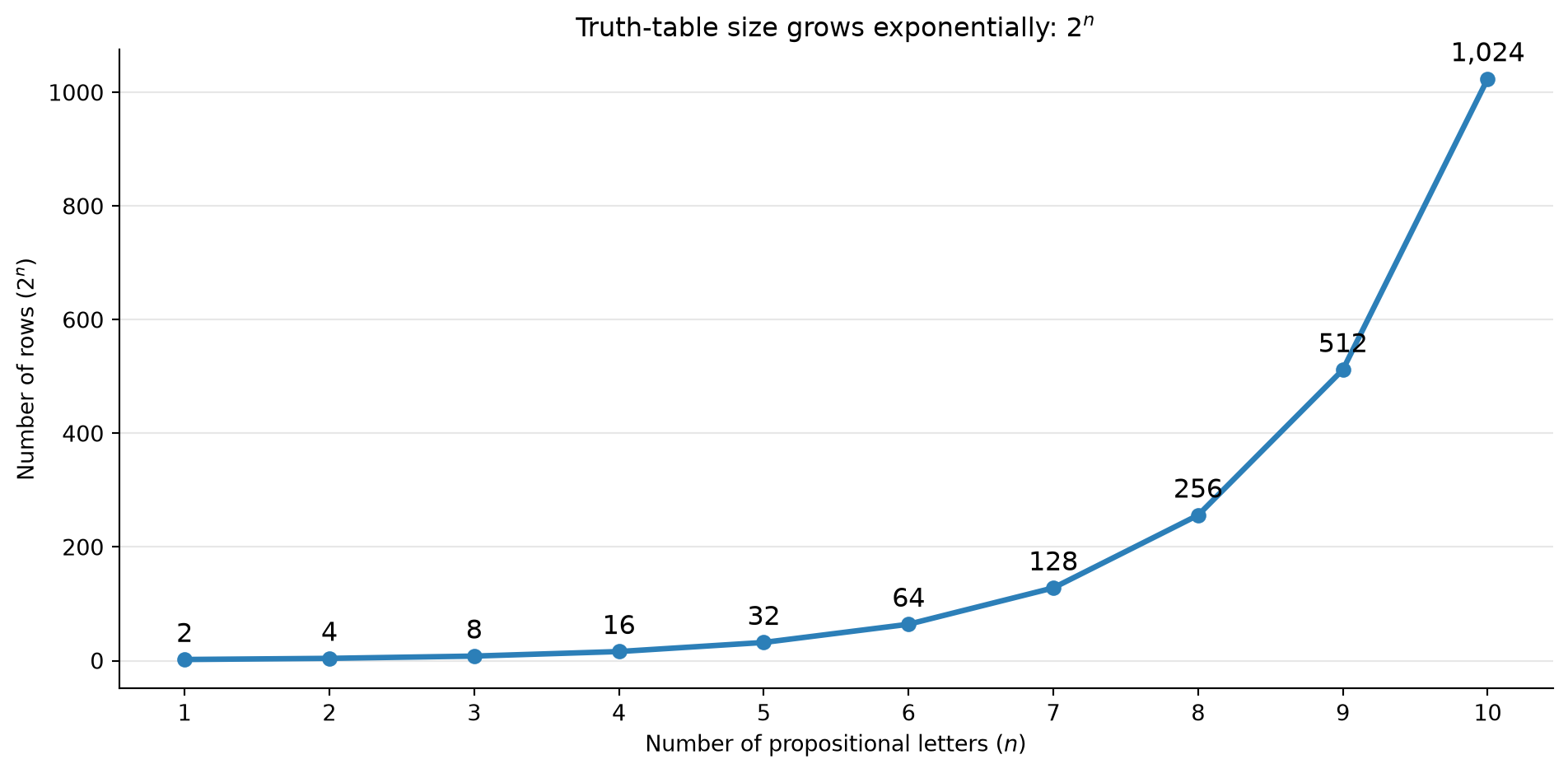
Ten Letters
- \(P, Q, R, T, W, S, C, D, A, B\)
- \(2^{10}=1024\) rows
- 1 row a minute = 1024 minutes = \(\approx\) 17.06 hours.
Problem 2: Exponential increase
For each new propositional letter \(n\), the table grows \(2^n\)
Solutions to Problem 2
- Solution 1: Create a New Test!
- Solution 2: Use computers